
AI is transforming legal work. It is not transforming what makes someone a lawyer.
As LAWCLERK CEO Greg Garman puts it: “Now you can buy intelligence and get things done in cases that you otherwise wouldn’t be able to do because before it just took too much time and money. AI gives you a bigger playbook to run a better practice.” The highest-value work in the profession still lives in judgment, narrative, and human discernment — areas where generative AI consistently falls short, no matter how fluent its output sounds. Firms that understand this distinction use AI aggressively for throughput, while protecting attorney time for the outcomes that actually require a lawyer.
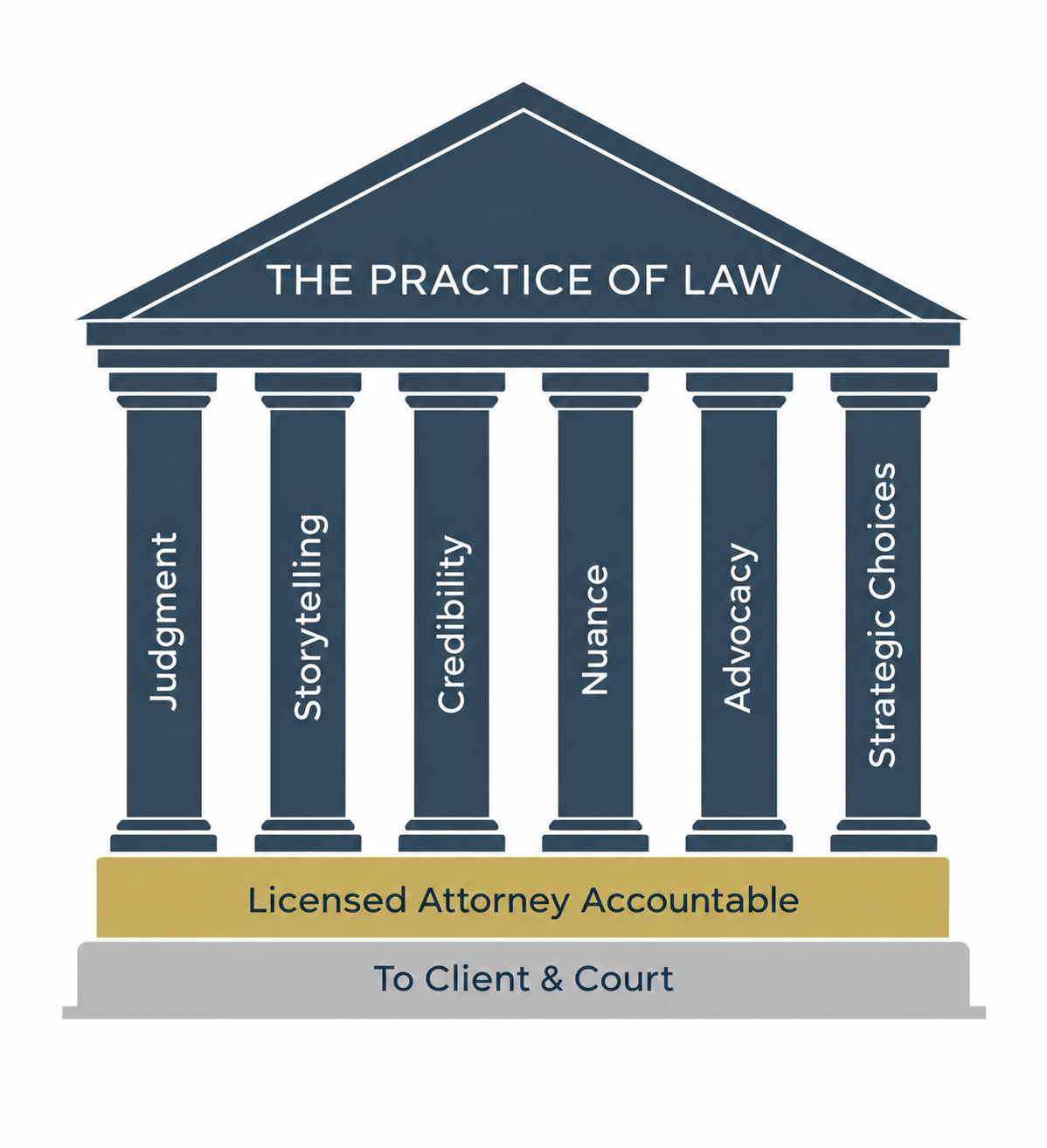
Here are six places where that line sits — and where it doesn’t move, no matter how good the tools get.
Judgment: Should We Pursue This Case at All?
Before any brief gets drafted or any discovery request goes out, clients need counsel on whether to act at all. That decision blends law, economics, reputation, emotion, and risk tolerance. AI can summarize rules and generate scenario outlines. It cannot sit across from a client and say, with accountability, “Here is what I recommend — and why I am staking my name on it.” A human lawyer weighs intangibles, reads the room, and owns the recommendation. AI produces options without professional responsibility for any of them.
Storytelling: What Story Will Move a Judge or Jury?
Trials and dispositive motions are won by coherent narrative, not by volume of authority. Connecting facts to theme — what happened, why it matters, what justice requires — demands taste, timing, and rhetorical judgment. AI can outline arguments. It cannot feel which fact should open your opening statement, or which detail will lose a jury in the first five minutes. A human lawyer crafts the story arc, the theme, and the emotional through-line. AI assembles paragraphs that may be technically fluent but strategically flat.
Credibility Assessment: Who Is Telling the Truth?
This is where AI’s limits are most visible. Many disputes are not resolved by abstract legal analysis — they turn on witness credibility, demeanor, inconsistency, motive, and how the evidence fits together in the real world. AI does not watch a witness hesitate. It does not weigh that a document “feels wrong” against years of trial experience. It can process a transcript; it cannot replace the lawyer who has learned what jurors believe and what they reject. A human lawyer evaluates testimony and evidence with lived courtroom context. AI summarizes what was said — not whether it will be believed.
Nuance and Context: When There’s No “Right Answer”
Legal problems are often messy: incomplete records, conflicting testimony, evolving business goals, and judges with individual tendencies. The correct move depends on client objectives, forum, opponent, and timing. AI tends toward average, pattern-matched answers — useful as a starting point, dangerous as a substitute for counsel. A human lawyer navigates ambiguity and advises in shades of gray. AI optimizes for plausible, statistically common outputs.
Advocacy: Reading the Room and the Trier of Fact
Effective advocacy requires pattern recognition and emotional intelligence — knowing when to press, when to concede, and how a fact-finder is likely to receive a given line of argument. That skill is honed over years of hearings, depositions, and trials. It is not reducible to a prompt. A human lawyer adapts in real time to judges, arbitrators, and juries. AI cannot perceive reaction, tension, or credibility in the moment.
Strategic Choices: Context, Not Templates
Some of the most consequential decisions in a case are structural, not doctrinal: jury trial versus bench trial versus arbitration, forum and choice of law, when to settle versus when to litigate, how aggressively to posture in early discovery. These choices are deeply context-dependent — the same clause or tactic that saves one client can harm another. AI may list pros and cons. Only a responsible attorney can recommend a path and answer for it under Rules 1.1 and 1.4. A human lawyer makes strategic calls tied to this client, this opponent, this judge. AI offers generic decision trees without accountability.
Where LAWCLERK Fits: Human Lawyers for Human Work
We connect firms with a nationwide network of freelance licensed attorneys for project-based work — research, drafting support, discovery, timelines, and more — under your supervision. The point isn’t to replace the judgment work described above. It’s to protect it.
| Delegate to AI (with governance) | Keep with human attorneys (you + LAWCLERK talent) |
|---|---|
| First drafts, summaries, chronology extraction | Case strategy, settlement posture, go/no-go advice |
| Bulk document processing | Credibility assessments and trial narrative |
| Marketing and admin content | Advocacy, client counseling, courtroom presence |
| Issue spotting and research prompts | Strategic forum and procedure decisions |
When AI handles volume, lead attorneys can spend more time on judgment, storytelling, and advocacy — the work clients actually hire them for. When that volume still exceeds capacity, we provide human lawyers to extend your team without diluting accountability:
- Free the partner — Offload cite-checked memos, discovery drafts, and research projects to a freelance attorney so partners stay focused on strategy and client relationships.
- Human verification layer — Route AI-generated work product to a licensed freelance lawyer for review before it reaches your desk.
- Elastic capacity — Scale for matter spikes without hiring ahead of demand.
- Specialized skill on demand — Match practice-area experience to a discrete project while you retain sign-off and professional responsibility.
The client comes to a lead attorney who owns judgment, strategy, and advocacy; AI provides speed on repeatable tasks; freelance lawyers through LAWCLERK handle delegated legal work as licensed humans; and the lead attorney certifies the final product to the client and the court.
AI is not coming someday — it is already reshaping the attorney’s role from sole producer to director, verifier, and certifier of legal work. Firms that build the infrastructure for that shift will move faster, serve clients better, and sleep easier. Firms that use AI ad hoc will eventually file something they cannot defend.
AI for speed. Human lawyers for judgment. LAWCLERK for scale.
Hire a freelance lawyer today and put a licensed human verification layer behind every AI-assisted work product your firm produces.
This article was developed with the assistance of AI tools and edited by Kristin Tyler.
FAQ: What AI Can and Cannot Do in Legal Practice
What can’t AI replace in legal practice?
Six things: the judgment call on whether to pursue a case at all, courtroom storytelling and narrative strategy, witness credibility assessment, navigating ambiguity in messy fact patterns, real-time advocacy in front of a judge or jury, and structural strategic choices like forum selection or when to settle. Each of these requires accountability, lived experience, and professional responsibility that a licensed attorney holds and AI does not.
Can AI decide whether a client should pursue a case?
No. AI can summarize rules and generate scenario outlines, but it cannot sit across from a client and say, with accountability, “Here is what I recommend — and why I am staking my name on it.” That decision blends law, economics, reputation, emotion, and risk tolerance, and only a human lawyer can weigh those intangibles and own the recommendation.
Can AI write a compelling trial narrative or opening statement?
AI can outline arguments, but it cannot feel which fact should open a statement or which detail will lose a jury in the first five minutes. Trials and dispositive motions are won by coherent narrative, not volume of authority, and crafting that story arc and emotional through-line remains a human skill built on taste, timing, and rhetorical judgment.
Can AI assess whether a witness is telling the truth?
No. AI can process a transcript, but it does not watch a witness hesitate or weigh that a document “feels wrong” against years of trial experience. Credibility assessment turns on demeanor, inconsistency, and motive — context a lawyer reads in the room, not on the page.
Why is AI risky for legal problems with no clear “right answer”?
Because AI tends toward average, pattern-matched answers, which are useful as a starting point but dangerous as a substitute for counsel. Legal problems are often messy — incomplete records, conflicting testimony, evolving business goals — and the correct move depends on client objectives, forum, opponent, and timing, which requires a human lawyer navigating ambiguity in shades of gray.
Can AI handle advocacy during a hearing or trial?
No. Advocacy requires pattern recognition and emotional intelligence — knowing when to press, when to concede, and how a fact-finder is likely to receive a given argument — honed over years of hearings, depositions, and trials. AI cannot perceive reaction, tension, or credibility in the moment, so a human lawyer has to adapt in real time to judges, arbitrators, and juries.
Can AI make strategic decisions like whether to settle or which forum to choose?
AI can list pros and cons, but only a responsible attorney can recommend a path and answer for it under Rules 1.1 and 1.4. Decisions like jury versus bench trial, forum and choice of law, or when to settle versus litigate are deeply context-dependent — the same tactic that helps one client can harm another — which is why they stay with a human lawyer accountable to this client, this opponent, and this judge.
How does LAWCLERK fit into a firm’s AI strategy?
LAWCLERK connects firms with a nationwide network of freelance licensed attorneys for project-based work — research, drafting support, discovery, timelines, and more — under the hiring attorney’s supervision. AI handles volume and first drafts, freelance lawyers provide a licensed human verification layer and extend capacity, and the lead attorney retains judgment, strategy, advocacy, and final sign-off on everything that reaches a client or a court.