
Vendor lists change constantly. Workflows endure. Instead of chasing the next tool, the more useful question for firm leaders is which categories of work AI is already improving — and what guardrails keep each one safe. Here are five, drawn directly from where firms are seeing real return today.
Marketing Content
Use cases: Blog and newsletter drafts, seminar descriptions, FAQ pages, social posts, and internal talking points.
AI is a genuine time-saver here, provided two guardrails hold: no client confidences ever go into the prompt, and a partner reviews everything before publication for advertising-ethics compliance (Florida Subchapter 4-7 and the analogous rules in other jurisdictions), including verifying any claims about results or rankings before they go live.
Partners reclaim hours for business development while keeping a consistent content calendar running in the background.
Document Review and E-Discovery
Use cases: First-pass relevance review, privilege triage, issue coding, contract clause extraction, and deposition summaries.
The numbers here are the most concrete in the whole AI conversation for law firms. Legal professionals expect AI to free up roughly 240 hours per year — about six workweeks. AI classification can shrink review populations by 30 to 50 percent before a human ever opens a document. And managed AI review has delivered 18-percent-plus faster completion in head-to-head studies against traditional review.
None of that eliminates the need for judgment. Validate the classification methodology before relying on it for large matters, document your training and validation process so it’s defensible if challenged, and never treat an AI privilege call as final without attorney review.
Timelines and Case Narratives
Use cases: Medical chronologies, deal timelines, day-of-event sequences, and trial-prep exhibit lists.
The workflow that works: AI extracts dates and events from the record, the attorney validates every single entry against primary sources, and a graphics team or trial consultant polishes the result for presentation. The mechanical sorting time drops sharply — the attorney’s time shifts to where it belongs, on strategy and impeachment planning.
Billable Hours and Operations
Use cases: Time-entry narrative suggestions, staffing forecasts, collections correspondence, and knowledge management.
This is also where ethics guidance gets specific. ABA Formal Opinion 512 and state guidance in Florida and Texas caution against double billing and require reasonable fees — meaning if AI meaningfully speeds up a task, that efficiency may need to be reflected in how you bill for it, or at minimum discussed with the client as part of a value-billing conversation rather than passed through silently on an hourly matter.
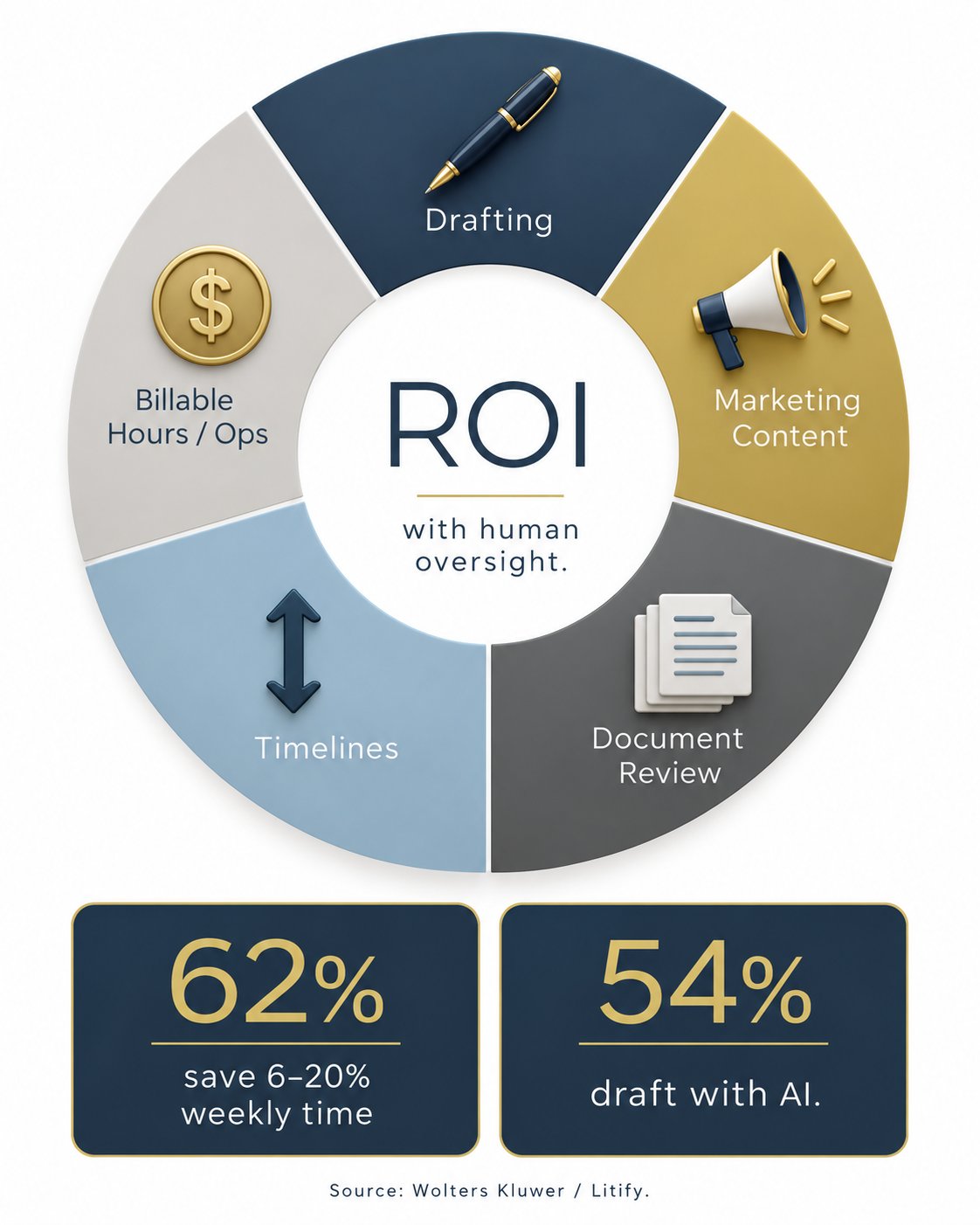
62 percent of legal professionals report saving 6 to 20 percent of weekly time using AI, and roughly half report 6-to-20-percent revenue increases after adoption.
Drafting Letters, Briefs, Memos, and Client Updates
Use cases: First drafts of correspondence, briefs, memos, and routine client updates.
The best-practice stack for drafting is four steps, in order: start from a firm template plus approved facts, let AI generate an outline, have the attorney shape the actual strategy and legal theory, run every citation through the integrity protocol described in our companion post on hallucination risk, and finish with a final human review in Word using track changes.
Adoption data explains why governance matters as much as access: 54 percent of legal professionals now use AI for document drafting, and among the tools they’re using, ChatGPT leads at 66 percent, followed by Microsoft Copilot at 42 percent and Google Gemini at 24 percent. A firm with that much tool diversity in daily use needs one consistent drafting protocol that works no matter which tool an individual attorney reaches for.
The Common Thread
Every one of these workflows follows the same shape: AI handles the volume and the first pass, and a licensed attorney validates, shapes, and certifies the result before it reaches a client, opposing counsel, or a court. That’s not a limitation on AI’s value — it’s the reason the value is durable instead of a liability waiting to surface.
When the volume still exceeds your team’s capacity even with AI in the mix, that’s where a network of vetted freelance attorneys earns its keep — extending your bench for document review, drafting support, and timeline-building without the overhead of a full-time hire.
See how LAWCLERK’s freelance attorney network can extend your team’s capacity today.
This article was developed with the assistance of AI tools and edited by Kristin Tyler.
FAQ: AI Workflows and ROI for Law Firms
Which law firm workflows are seeing the most measurable ROI from AI today?
Five stand out: marketing content, document review and e-discovery, timelines and case narratives, billable hours and operations, and drafting letters, briefs, memos, and client updates. Document review has the most concrete numbers — legal professionals expect AI to free up roughly 240 hours per year, about six workweeks, and AI classification can shrink review populations by 30 to 50 percent before a human opens a document.
Can AI be used to write law firm marketing content?
Yes, with two guardrails: no client confidences ever go into the prompt, and a partner reviews everything before publication for advertising-ethics compliance, including verifying any claims about results or rankings before they go live. Done that way, AI handles blog drafts, newsletters, seminar descriptions, FAQ pages, and social posts while partners reclaim hours for business development.
How much time can AI actually save in document review and e-discovery?
Legal professionals expect roughly 240 hours a year back — about six workweeks — and AI classification can shrink review populations by 30 to 50 percent before a human ever opens a document. In head-to-head studies, managed AI review has delivered 18-percent-plus faster completion than traditional review.
Does using AI for document review eliminate the need for attorney oversight?
No. Firms still need to validate the classification methodology before relying on it for large matters, document the training and validation process so it’s defensible if challenged, and never treat an AI privilege call as final without attorney review. AI accelerates the first pass; judgment and sign-off stay with the attorney.
How does AI use affect billing and time entries?
ABA Formal Opinion 512 and state guidance in Florida and Texas caution against double billing and require reasonable fees, so if AI meaningfully speeds up a task, that efficiency may need to show up in how the task is billed, or at least be discussed with the client as part of a value-billing conversation rather than passed through silently on an hourly matter. The upside is measurable: 62 percent of legal professionals report saving 6 to 20 percent of weekly time using AI, and roughly half report 6-to-20-percent revenue increases after adoption.
What’s the best-practice process for drafting documents with AI?
Four steps, in order: start from a firm template plus approved facts, let AI generate an outline, have the attorney shape the actual strategy and legal theory, run every citation through a citation-integrity protocol, and finish with a final human review in Word using track changes.
Which AI tools are law firms actually using for drafting?
54 percent of legal professionals now use AI for document drafting. Among the tools in use, ChatGPT leads at 66 percent, followed by Microsoft Copilot at 42 percent and Google Gemini at 24 percent — enough tool diversity that firms need one consistent drafting protocol that works no matter which tool an attorney reaches for.
What’s the one safeguard every AI workflow in a law firm needs?
A licensed attorney must validate, shape, and certify the result before it reaches a client, opposing counsel, or a court. AI can handle volume and the first pass across marketing, review, timelines, billing, and drafting, but that human validation step is what makes the value durable instead of a liability waiting to surface.