
The Legal Talent Market Has Changed — Your Hiring Strategy Should Too
If you’re running or managing a law firm right now and trying to hire associate attorneys, you already know the frustrating reality: the talent isn’t just expensive — it’s scarce.
As we covered in our recent piece, The Great Legal Talent Shortage: Why Law Firms Are Struggling to Hire in 2026, legal unemployment sits at a historically low 1.4%, law school enrollment has dropped nearly 30% from its 2010 peak, and Big Law firms are offering $200,000+ starting salaries that mid-size and small firms simply cannot match. The result? A market where there is no surplus of hungry, unemployed lawyers waiting by the phone.
In this environment, two options dominate the conversation for firms looking to add associate capacity: hire a legal recruiter (aka headhunter) — or use a platform like LAWCLERK to access vetted freelance attorneys on demand. These are not equivalent choices. This post breaks down exactly how each works, what it actually costs you, and why a growing number of law firms are choosing LAWCLERK.
How Legal Headhunters Work — and What They Actually Cost You
Legal recruiting firms — commonly called headhunters — operate on a straightforward economic model: they find candidates for law firms and charge a fee when a placement is made. That fee is almost always a percentage of the hired attorney’s first-year compensation, typically ranging from 20% to 30%.
When you factor in that a mid-size firm’s first-year associate often commands a salary in the $130,000–$180,000 range, you’re looking at a recruiting fee of $26,000 to $54,000 — before the associate has billed a single hour.
Here’s how the headhunter model breaks down for law firms:
- You pay whether it works out or not — most agencies offer limited guarantee windows of 60–90 days
- The search takes time — lateral hiring timelines typically run 3 to 6 months from engagement to offer acceptance
- You inherit all ongoing overhead — salary, benefits, malpractice coverage, office space, technology, and training
- You take on the hiring risk — if caseloads drop, you’re still paying full-time compensation
The LAWCLERK Model: Start Free, Pay Only for What Gets Done
LAWCLERK operates on a completely different premise. Rather than charging placement fees, LAWCLERK connects law firms directly with a network of 7,000+ vetted, U.S.-licensed freelance attorneys available for project-based or ongoing work — and it costs nothing to get started.
- Create a free account on LAWCLERK — no setup fees, no subscription required
- Post an opportunity describing the work you need (a brief, a motion, contract review, legal research, a memo) — or post a role for hourly engagements if you’re looking for a more consistent arrangement. You can also browse attorney profiles to find someone who matches your need.
- Review applicants — every LAWCLERK attorney has been vetted and can share 58+ data points across 8 profile categories: education, experience, practice area, rate and availability, skills, accomplishments, bar associations, and preferences
- Hire and pay only when work is delivered — no fees unless a project is completed, or pay on a pay-as-you-go basis for hourly engagements
This pay-for-performance structure means your firm is never paying for bench time, administrative overhead, or a seat that isn’t producing billable output. If your caseload spikes, you scale up. If it drops, you scale back — with zero commitment, termination costs, or HR complications.
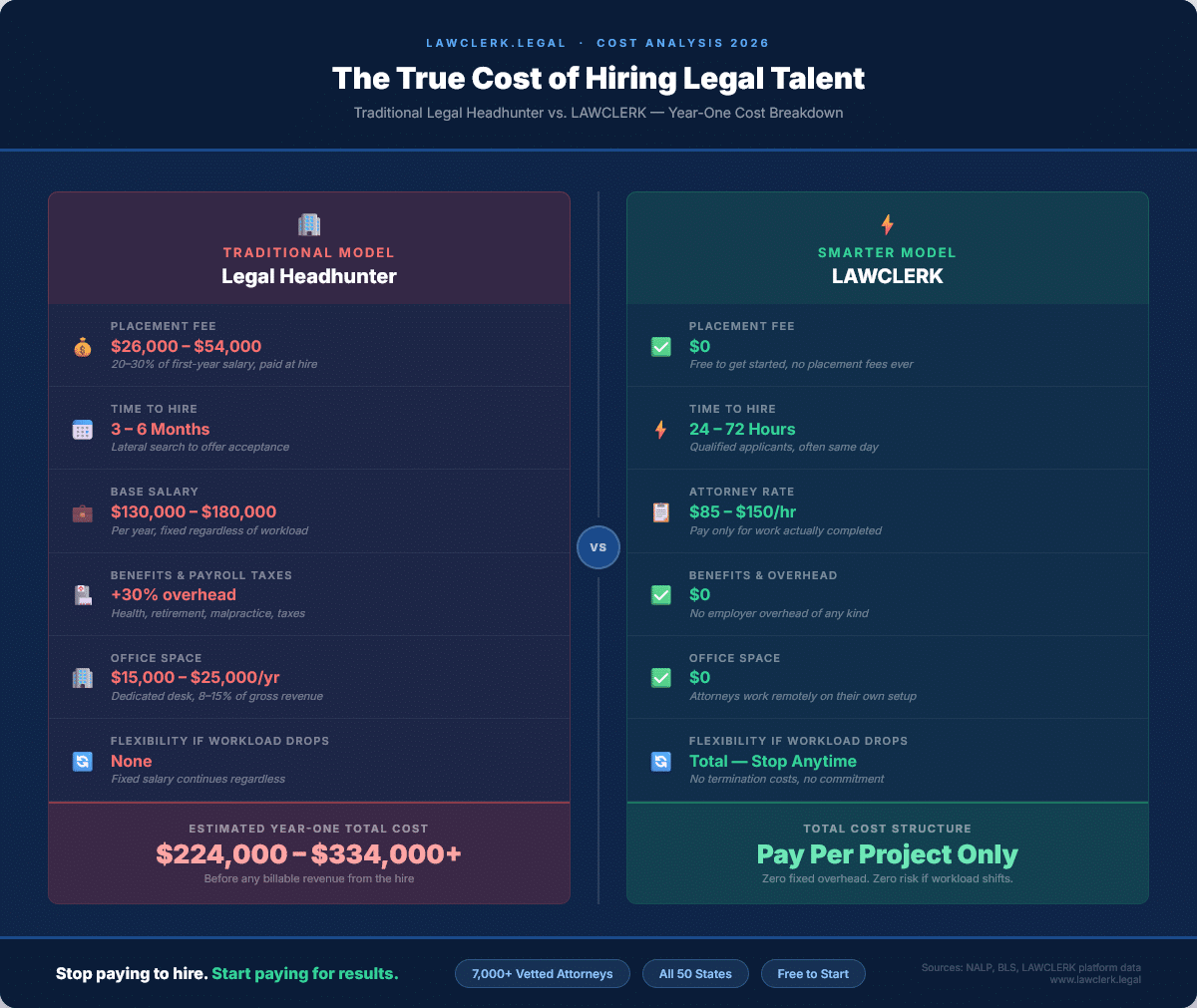
LAWCLERK vs. Legal Headhunters: Side-by-Side
| Factor | Legal Headhunter | LAWCLERK |
|---|---|---|
| Cost to get started | $0 upfront, but 20–30% fee at placement | Free — $0 |
| Placement / access fee | $26,000–$54,000+ per hire | $0 |
| Time to access talent | 3–6 months | 24–72 hours |
| Ongoing commitment | Full-time salary + benefits + overhead | Pay only for work completed |
| Flexibility | Low — permanent hire | High — scale up or down anytime |
| Vetting process | Varies by firm | 58+ data points, 8 categories |
| Geographic access | Local / regional focus | All 50 states, every practice area |
| Risk if workload drops | You still pay full salary | Zero — no work, no cost |
| Sources: NALP, U.S. Bureau of Labor Statistics, LAWCLERK platform data. Salary ranges reflect mid-size firm market rates as of 2026. | ||
The Flexibility Advantage: Stop Hiring for Average Workload
One of the most underappreciated costs of traditional associate hiring — whether through a recruiter or direct — is the economic inefficiency of hiring for average workload when legal work is inherently cyclical.
Law firms don’t have perfectly smooth, predictable demand. Litigation spikes during certain periods. Transactions cluster around quarter-end. Estate planning seasons ebb and flow. When you hire a full-time associate, you’re paying 12 months of salary to staff for what might be 7–9 months of true peak-capacity need.
Freelance attorneys through LAWCLERK give you the ability to staff to demand, not to average. When a big case comes in, you post an opportunity. When the matter closes, you don’t have an idle associate on your payroll.
This flexibility also removes a painful constraint from your decision-making. According to data cited in our talent shortage analysis, mid-size firms are turning away approximately 15–20% of potential matters due to capacity constraints. That’s not a staffing problem. That’s a revenue problem. With LAWCLERK, you don’t have to choose between overstaffing for slow periods and understaffing for busy ones.

The Economic Reality of Overhead: What Remote Associates Actually Save
The comparison between LAWCLERK and headhunters doesn’t end at the placement fee. It extends to everything that comes after a traditional hire. As we detailed in Five Ways Your Law Firm Can Save on Overhead by Working with Remote Associates, the fully loaded cost of a traditional associate goes well beyond salary:
- Office space: Law firm space typically costs 8–15% of gross revenue
- Benefits and payroll taxes: Add 25–35% on top of base compensation
- Technology and equipment: Workstations, software licenses, IT support
- Administrative burden: 1099/W-2 management, HR compliance, onboarding costs
- Underperformance risk: 84.4% of surveyed law firms report chronically underperforming attorneys still drawing full salaries
When you work with a LAWCLERK freelance attorney, none of these apply. LAWCLERK handles 1099 administration. The attorney works remotely from their own setup. You pay a flat fee or hourly rate for completed work — and that’s it.
The financial arithmetic is compelling. A freelance attorney billing at $85–$150 per hour through LAWCLERK versus a full-time associate at $220,000–$270,000 in total annual cost represents a meaningful structural advantage — especially for firms managing fluctuating workloads.
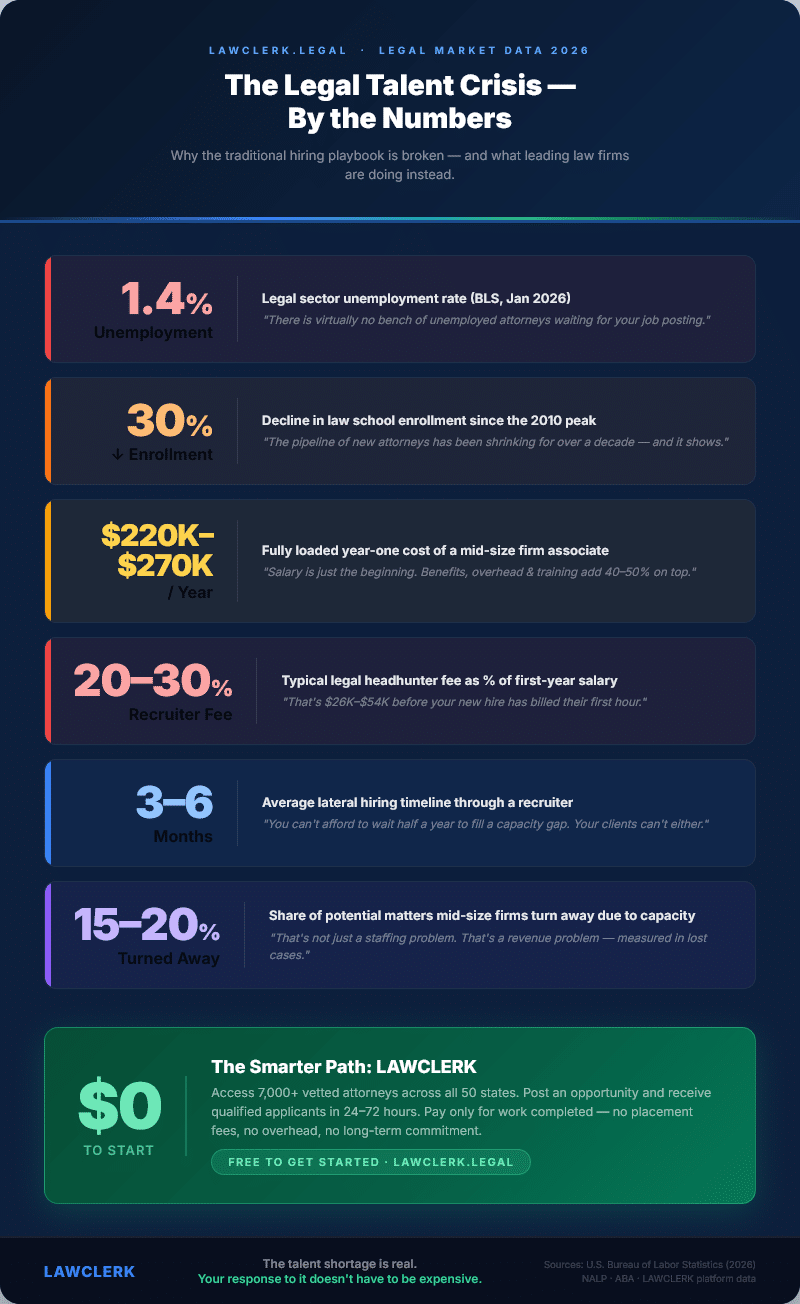
Finding Great Talent Faster: Days, Not Months
In today’s tight legal market, speed matters as much as cost. A matter doesn’t wait for a 4-month recruiting process. LAWCLERK’s network of 7,000+ attorneys spans all 50 states and virtually every practice area — and when you post an opportunity, you typically see qualified applicants within 24 to 72 hours.
Contrast that with the 3–6 month lateral hiring timeline for a traditional associate placement, and the operational advantage becomes obvious. With LAWCLERK, you’re not forecasting 6 months into the future to predict staffing needs. You’re responding to actual demand in real time.
Frequently Asked Questions
Is it really free to get started with LAWCLERK?
Yes. Creating an account on LAWCLERK costs nothing. You only pay when a project is completed and you are satisfied with the work delivered.
How much do legal headhunters charge law firms?
Legal recruiting firms typically charge 20–30% of a placed attorney’s first-year compensation as a placement fee. For an associate earning $150,000, that’s $30,000–$45,000 — paid as a lump sum at placement.
How quickly can I find a freelance attorney through LAWCLERK?
Most firms receive qualified applicants within 24–72 hours of posting an opportunity, compared to 3–6 months for a traditional lateral hire through a recruiter.
What types of work can LAWCLERK attorneys handle?
LAWCLERK attorneys can handle virtually any legal work that can be supervised remotely — legal research, brief writing, contract review and drafting, discovery, due diligence, motions, memos, appellate work, and more. LAWCLERK also offers opportunities for attorneys to make court appearances, depending on your need.
How does LAWCLERK vet its attorneys?
Every LAWCLERK freelancer is a U.S.-licensed attorney. LAWCLERK verifies identity and confirms each attorney is in good standing with their respective Jurisdictional Bar.
Is using a freelance attorney through LAWCLERK ethically compliant?
Yes. ABA Formal Opinions 00-420 and 08-451 confirm that attorneys may ethically use contract lawyers and bill their services at market rates, provided appropriate supervision is maintained. LAWCLERK was built by attorneys with these ethics rules in mind.
The Bottom Line: A Smarter Path to Top Legal Talent
The legal talent market isn’t going to get easier. Law school enrollment is still below historical peaks. Unemployment among legal professionals remains near historic lows. Big Law’s compensation escalation isn’t slowing down.
In that environment, paying $30,000–$50,000 placement fees to a headhunter — and then committing to $220,000–$270,000 in annual fully loaded cost for a full-time hire — is a significant bet. It may be the right bet for some positions. But for the associate-level capacity most firms need to handle day-to-day workload and overflow, there is a faster, more flexible, and dramatically more cost-effective path.
LAWCLERK lets you access top legal talent from across the country in days, not months — with no placement fees, no overhead commitments, and no risk if workloads shift. You post a project, review vetted attorneys, and pay only for work that gets done.
Or book some time today with our team to learn more.
This article was developed with the assistance of AI tools and edited by Kristin Tyler.