
When the corporate practice group at your mid-size firm lands a major deal, they need attorneys—yesterday. When a senior associate gives two weeks’ notice, you need a replacement—fast. When litigation ramps up for back-to-back trials, you need additional capacity—now.
But here’s the reality: The attorney you need doesn’t exist in your local market. Or they want $40,000 more than your budget allows. Or they’re interviewing at three other firms and will take the highest offer. Or they can’t start for 90 days. Or all of the above.
Welcome to 2026’s legal talent shortage—a perfect storm of demand, demographics, and disruption that’s hitting mid-size firms harder than anyone else. If you feel like you’re fighting an unwinnable battle for qualified attorneys, you’re not imagining it. The data backs up what you already know: traditional hiring is broken, and mid-size firms are caught in the worst position.
The Forces Behind the Legal Talent Shortage
The current attorney hiring crisis isn’t a temporary blip. It’s the result of converging trends that have fundamentally changed the legal labor market. In addition, unemployment in legal is incredibly low. As of January 2026, the U.S. Bureau of Labor Statistics reports unemployment for “Legal Occupations” at 1.4%. Source: BLS Current Employment Statistics. This means we have a tight labor market where not a lot of lawyers are out looking for jobs. More likely lawyers currently have a job but remain open to other opportunities if they arise – especially more lucrative opportunities.
The Demographics Problem
The legal profession is graying faster than it’s replenishing. According to the American Bar Association, the median age of attorneys has increased steadily over the past two decades. Baby Boomer partners are retiring, taking decades of institutional knowledge with them. Meanwhile, law school enrollment has declined approximately 30% from its 2010 peak, meaning fewer new attorneys are entering the profession each year.
For mid-size firms, this creates a double bind. You’re losing senior talent to retirement while competing for a shrinking pool of junior talent. The math simply doesn’t work.
The Big Law Salary Arms Race
In recent years, major law firms have pushed starting associate salaries well above $200,000 in major markets. This jump in associate salaries cascaded throughout the legal industry. While mid-size firms can’t always match these numbers, they’re competing for the same candidates. The result? Top law school graduates overwhelmingly choose big law, at least initially.
Even when you do hire promising associates, retention becomes the next challenge. Big law firms actively recruit experienced attorneys from mid-size firms, often offering $50,000+ salary increases. You invest time and resources training attorneys, only to see them poached by competitors.
The Geographic Constraint
Pre-pandemic, mid-size firms primarily recruited from their local market. That was already challenging in secondary markets with limited law school pipelines. Post-pandemic, candidates expect remote work options, but many mid-size firm partners remain skeptical about fully remote attorneys.
This puts you in a bind: Your geographic talent pool is too small, but your partners aren’t ready to embrace nationwide remote hiring. Meanwhile, your competitors who do offer remote flexibility have a significant recruiting advantage.
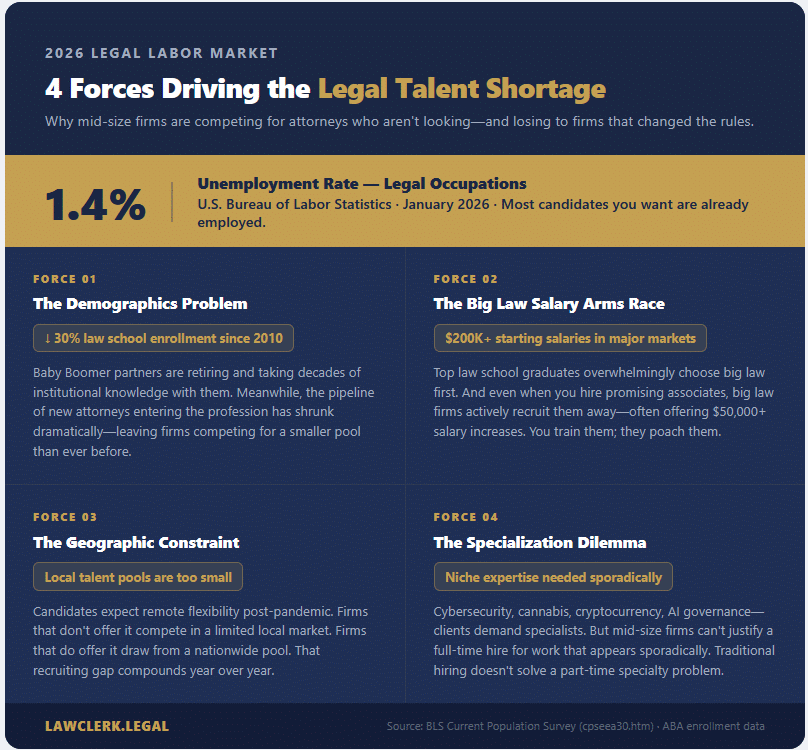
4 forces driving the 2026 legal talent shortage. Source: BLS Current Population Survey · ABA enrollment data.
The Specialization Dilemma
Legal work has become increasingly specialized. Clients want attorneys with specific experience in niche practice areas—cybersecurity law, cannabis regulation, cryptocurrency, AI governance. Your firm occasionally needs these specialties, but not enough to justify a full-time hire.
Traditional recruiting doesn’t solve this problem. You can’t hire a full-time specialist for work that appears sporadically. But you also can’t serve clients effectively without access to that expertise.
Why Mid-Size Firms Get Hit Hardest
The legal talent shortage affects firms of all sizes, but mid-size firms—typically 11 to 50 attorneys—face unique challenges that make the crisis particularly acute.
Caught Between Two Worlds
Small firms (2-10 attorneys) can often operate with a small, stable team supplemented by of-counsel relationships and contract help. Large firms (100+ attorneys) have dedicated recruiting departments, expansive budgets, and brand recognition that attracts candidates.
Mid-size firms fall in between. You’re too large to operate with just a handful of attorneys, but too small to have the recruiting infrastructure and compensation packages of big law. You need the talent pipeline of a large firm but often have recruiting resources comparable to a small firm.
The Cost-Benefit Squeeze
Here’s the fundamental economic challenge: A first-year associate in a mid-market city now costs approximately $180,000-$220,000 when you factor in salary, benefits, payroll taxes, and overhead. That’s before considering recruiting fees, which typically cost at least 20-25% of first-year compensation—another $40,000-$50,000.
For a mid-size firm to justify this investment, that associate needs to bill approximately 1,500-1,700 hours annually at rates your market will bear. But here’s the problem: work doesn’t arrive in predictable, steady streams. Practice groups experience feast or famine cycles. One quarter you’re desperate for help; the next quarter your associates are underutilized.
Large firms can absorb these fluctuations across dozens of attorneys and practice groups. Small firms can scale their modest teams up or down more easily. Mid-size firms lack both luxuries. You’re large enough that staffing inefficiency significantly impacts profitability, but not large enough to smooth out the peaks and valleys.
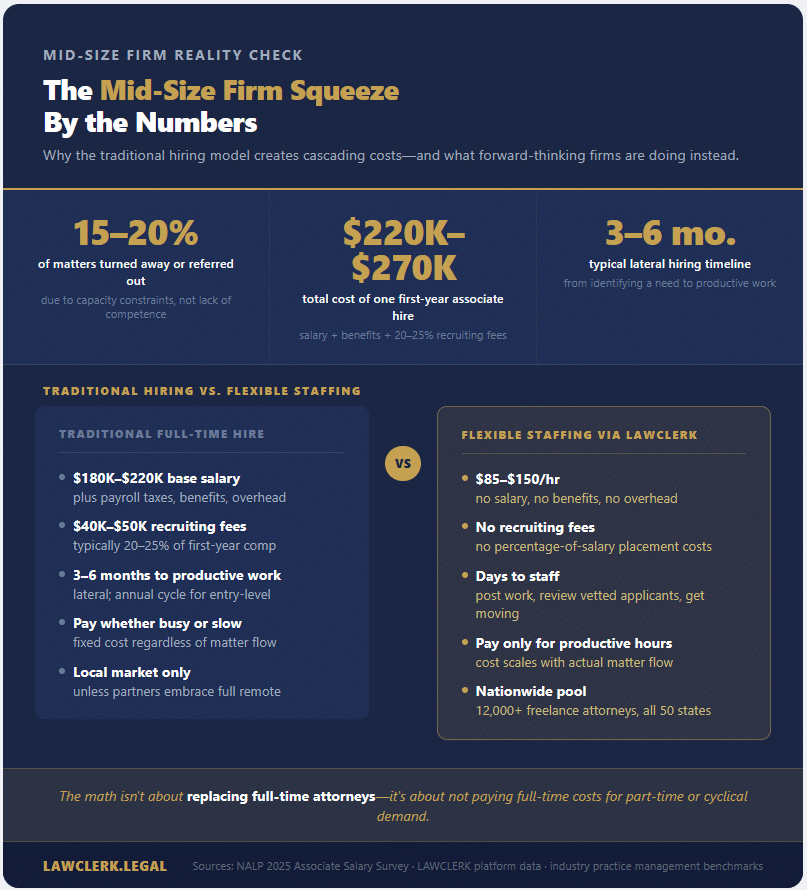
The mid-size firm squeeze, by the numbers. Sources: NALP 2025 Associate Salary Survey · LAWCLERK platform data · industry practice management benchmarks.
The Timeline Problem
Traditional attorney recruiting operates on timelines that don’t align with client needs. Law school recruiting happens in fall for positions starting the following September—nearly a year out. Lateral hiring typically takes 3-6 months from identifying a need to having someone productive.
But your clients don’t plan litigation, deals, or regulatory matters around your recruiting timeline. When a major case lands, you need help within days or weeks, not months. When an associate departs unexpectedly, you need coverage immediately. Traditional hiring simply cannot match the speed modern law practice demands.
The Jack-of-All-Trades Trap
Mid-size firms often need attorneys who can handle multiple practice areas or matter types—the litigator who can handle both commercial disputes and employment matters, the transactional attorney comfortable with M&A and commercial real estate.
These versatile attorneys are increasingly rare. New attorneys emerging from law school are more specialized. Experienced attorneys have often niched down to specific practice areas. The generalist attorney who can pivot between practice areas—once the backbone of mid-size firms—is becoming an endangered species.
The Hidden Costs of Hiring Struggles
The legal talent shortage creates costs that extend far beyond recruiting fees and salaries. For mid-size firms, the inability to staff matters effectively creates a cascade of problems.
Revenue Leakage
When you can’t staff a matter properly, one of three things happens: you turn down the work, you take it on but deliver suboptimal service, or you burn out your existing team trying to handle overflow. All three options cost you money.
According to practice management data, mid-size firms report turning away or referring out approximately 15-20% of potential matters due to capacity constraints. That’s direct revenue walking out the door—not because you lack competence, but because you lack capacity.
Quality and Client Service Risks
Overworked attorneys make mistakes. When your existing team is stretched thin covering for unfilled positions, the risk of errors increases. A missed deadline, an overlooked detail, or inadequate research can damage client relationships and expose the firm to malpractice claims.
Perhaps more insidiously, overworked attorneys provide adequate work product rather than excellent work product. They don’t have time for the thorough research, creative problem-solving, or proactive client communication that distinguishes exceptional service. Your clients may not leave immediately, but they’re vulnerable to solicitation from firms with better-resourced teams.
Talent Burnout and Retention
Here’s the vicious cycle: Unfilled positions mean your existing attorneys work longer hours. Overworked attorneys become dissatisfied and leave. Their departures create additional unfilled positions, further overworking the remaining team.
Mid-size firms already struggle to retain associates competing against big law’s compensation and small firm’s lifestyle. When you add chronic overwork from understaffing, retention becomes nearly impossible. Each departure triggers recruiting costs and lost productivity, perpetuating the cycle.
Lost Growth Opportunities
Strategic growth requires staffing flexibility. When a firm identifies an emerging practice area or geographic market, capitalizing on that opportunity requires talent. But if you’re struggling to staff existing matters, you certainly can’t invest in growth initiatives.
The firms winning in 2026 are those that can scale quickly when opportunities arise. If your growth is constrained by hiring timelines measured in months rather than weeks, you’re leaving opportunities on the table.
How Forward-Thinking Firms Are Adapting
The good news: Mid-size firms aren’t helpless in the face of these challenges. While traditional hiring remains difficult, innovative firms are rethinking their approach to building attorney teams.
Embracing Flexible Staffing Models
The most significant shift is recognizing that not every attorney role requires permanent, full-time employment. Forward-thinking firms are building what we call “hybrid teams”—a core of full-time attorneys supplemented by flexible capacity that scales up or down based on actual work.
This isn’t the contract attorney model of decades past, where firms reluctantly hired temporary help for document review projects. Modern flexible staffing provides access to experienced attorneys—often with 10-15+ years of practice—who work on substantive matters ranging from research and drafting to court appearances and client counseling.
Leveraging Technology Platforms
The rise of legal talent platforms has fundamentally changed access to freelance attorney capacity. Rather than relying on personal networks or local bar associations to find contract help, firms can now access nationwide networks of vetted attorneys.
Platforms like LAWCLERK connect firms with over 12,000 freelance attorneys across all 50 states and virtually every practice area. These aren’t desperate attorneys looking for any work—they’re experienced professionals who’ve chosen flexibility over full-time employment. Many are former big law attorneys, retired partners staying active in practice, or attorneys prioritizing work-life balance.
What makes this model work for mid-size firms is the precision and speed. Instead of months-long searches for the perfect unicorn candidate, you can identify attorneys with the exact experience you need in days. Need someone with 15 years of insurance defense experience in Pennsylvania for a three-week project? That person exists, and you can find them.
Rethinking Attorney Economics
The traditional model assumes attorneys must bill 1,700-2,000 hours annually to justify their cost. But this creates the utilization problem—you’re paying for capacity whether you need it or not.
Flexible staffing flips this equation. Instead of paying for an associate’s full-time salary, benefits, and overhead regardless of workload, you pay only for productive hours when you actually need them. A freelance attorney might bill $85-$150 per hour with no additional overhead, recruiting fees, or benefits costs. You can bill clients at your standard associate rates, maintaining healthy margins without the utilization risk.
For mid-size firms operating on tight profitability margins, this math is compelling. The difference between a fully-loaded first-year associate ($180,000-$220,000 annually) and project-based freelance support (pay only when you need it) can meaningfully impact the bottom line.
Building Benches, Not Just Filling Seats
The smartest mid-size firms aren’t using flexible staffing as a band-aid for failed recruiting. They’re strategically building relationships with freelance attorneys who become virtual extensions of their teams.
When you work with the same freelance attorneys repeatedly, they learn your firm’s standards, client expectations, and practice preferences. They become reliable capacity you can deploy quickly when needs arise—without the overhead of permanent employment.
Some firms develop ongoing relationships through structured programs. LAWCLERK’s Hourly Associate program, for example, enables firms to establish continuing relationships with freelancers for regular, predictable support—the feel of having an associate without the permanent commitment.
A Practical Path Forward
The legal talent shortage isn’t resolving anytime soon. Demographics, economics, and competitive dynamics will continue making traditional hiring challenging for mid-size firms.
But you’re not trapped. The firms thriving in this environment are those willing to rethink how they build teams and access talent. Flexible staffing isn’t about replacing your full-time attorneys—it’s about supplementing them strategically so you can:
- —Say yes to more work without adding permanent overhead
- —Access specialized expertise when you need it without maintaining specialists on staff
- —Flex capacity during busy periods without leaving associates underutilized during slow periods
- —Reduce time-to-staff from months to days
- —Compete effectively for work without matching big law’s staffing costs
The legal profession is evolving. The question isn’t whether mid-size firms can survive the talent shortage using traditional hiring alone—they can’t. The question is whether they’ll adapt quickly enough to turn a crisis into a competitive advantage.
Ready to rethink how you build your associate team? LAWCLERK connects mid-size firms with experienced remote attorneys nationwide. Access the talent you need without the recruiting fees, overhead, or long timelines of traditional hiring.
Ready to rethink how you build your associate team?
LAWCLERK connects mid-size firms with experienced remote attorneys nationwide. Access the talent you need without the recruiting fees, overhead, or long timelines of traditional hiring.
This article was developed with the assistance of AI tools and edited by Kristin Tyler.
FAQ: Legal Talent Shortage, Mid-Size Firms, and Flexible Staffing
What is causing the legal talent shortage in 2026?
Four converging forces: (1) an aging attorney workforce with law school enrollment down roughly 30% since 2010, (2) a Big Law salary arms race pushing starting compensation above $200,000, (3) geographic recruiting constraints in secondary markets, and (4) growing demand for niche specializations that mid-size firms can’t justify as full-time hires. All of this plays out against a 1.4% unemployment rate for Legal Occupations (BLS, January 2026)—meaning the attorneys you want are almost certainly already employed.
Why are mid-size law firms hit hardest by attorney hiring challenges?
Mid-size firms (typically 11–50 attorneys) fall between two worlds. Small firms can operate lean with a handful of attorneys and contract help. Large firms have dedicated recruiting departments, strong brand recognition, and outsized compensation budgets. Mid-size firms need the talent pipeline of a large firm but often have the recruiting resources of a small one—making every hiring gap disproportionately disruptive.
How much does it really cost to hire a first-year associate at a mid-size law firm?
The fully loaded cost typically runs $220,000–$270,000 when you combine base salary ($180,000–$220,000), recruiting fees (20–25% of first-year compensation, or $40,000–$50,000), payroll taxes, benefits, and overhead. That figure doesn’t include lost productivity during the ramp period or the management time invested in onboarding.
How long does lateral attorney hiring take?
Lateral hiring typically takes three to six months from identifying the need to having someone productive. Law school entry-level hiring follows an annual cycle tied to bar admissions, making it unsuitable for responding to immediate staffing gaps. Neither timeline aligns with the pace at which clients generate urgent matters.
What percentage of work are understaffed law firms turning away?
According to practice management benchmarks, mid-size firms report turning away or referring out approximately 15–20% of potential matters due to capacity constraints—not lack of competence. That is direct revenue walking out the door while fixed overhead continues.
What is flexible legal staffing and how does it work for law firms?
Flexible legal staffing connects law firms with experienced freelance attorneys on a project or ongoing basis, rather than through permanent employment. Firms pay only for productive hours on actual matters—no recruiting fees, no benefits, no overhead. The supervising attorney retains full ethical responsibility for the work, just as with any delegation to an associate.
How is LAWCLERK different from traditional attorney recruiting?
LAWCLERK is a legal-specific platform connecting firms with vetted freelance attorneys across all 50 states and virtually every practice area. Instead of a months-long search, firms post work, review applicants with rich structured profiles, run conflicts, and can begin matters within days. Billing is by the hour with no placement fee, so cost tracks directly to actual work performed.
Can remote freelance attorneys handle substantive legal work—not just document review?
Yes. The freelance attorneys available through platforms like LAWCLERK include experienced practitioners—many with 10–15+ years of practice—who handle substantive work: research and drafting, transaction support, court appearances, and client counseling. These are attorneys who have chosen flexible arrangements, not attorneys who couldn’t find traditional positions.