Earlier this year, I attended the annual ABA TECHSHOW conference in Chicago. It is always one of the best legal conferences of the year, because we get to see the latest developments in technology and hear from thought leaders across the industry.
One day, while I was at the LAWCLERK booth in the expo hall, a man walked by. I noticed on his name badge that he was from a small town in Texas that I had never heard of. I casually asked whether his firm had any hiring plans this year.
He replied, “Yes, my firm is always hiring, but you probably can’t help us because we only hire part-time remote lawyers.”
That stopped me in my tracks. I was not expecting that answer. I was expecting him to say something closer to the default that he only hires full-time, in-office associates which is the model most law firms still associate with “real” hiring.
Instead, he surprised me in the best way possible. His comment affirmed something important: law firms can and do change. Flexible arrangements for part-time capacity, delivered remotely, are not a fringe experiment anymore. They are part of how modern law firms scale.
This article is for managing partners, firm leaders, and legal administrators who are responsible for keeping workflow moving when matter volume grows. When you need associate-level help, you are not only competing on salary and culture. You are competing on speed—how quickly you can identify, vet, and deploy talent when deadlines do not wait.
Why hiring velocity matters in 2026
If your firm is busy, you already feel the pressure. Associates are not sitting on the sidelines waiting for your job posting. For context on the structural shortage of available talent and why recruiting often feels like it is built for a different decade, see our overview, The Great Legal Talent Shortage: Why Law Firms Are Struggling to Hire in 2026.
Labor market data tells part of the story. According to the U.S. Bureau of Labor Statistics, unemployment for Legal Occupations was 1.4% in January 2026. This means we are in an environment where most candidates you want are already employed, not scrolling job boards full-time. Source: BLS Current Population Survey table (unemployment rates by occupation).
When the pool of immediately available lawyers is thin, hiring velocity—the time from “we need help” to “work is underway”—becomes a competitive advantage. The firms that scale fastest are not always the ones with the biggest recruiting budgets. Often, they are the ones that stopped treating every staffing gap like a multi-month lateral search.
A note for mid-size firms and administrators
If you are at a mid-size firm, you may feel this tension most acutely. You are large enough to have steady matter flow, internal process, and real client expectations. Yet, you are not always large enough to carry a full-time recruiting function, a deep bench in every practice area, and the luxury of long ramp times. Legal administrators, in particular, are often asked to make the operation run smoothly while partners ask for “more help” on impossible deadlines. In that environment, the question is not whether remote or flexible staffing is theoretically acceptable. The question is whether your firm can deploy capacity without turning every urgent need into an executive search.
That is exactly where the Texas conversation at TECHSHOW landed for me: not ideology—operations. When a firm says it is “always hiring” but only on a flexible-remote basis, what it often means is that leadership has aligned staffing with fluctuating demand instead of pretending demand is predictable.
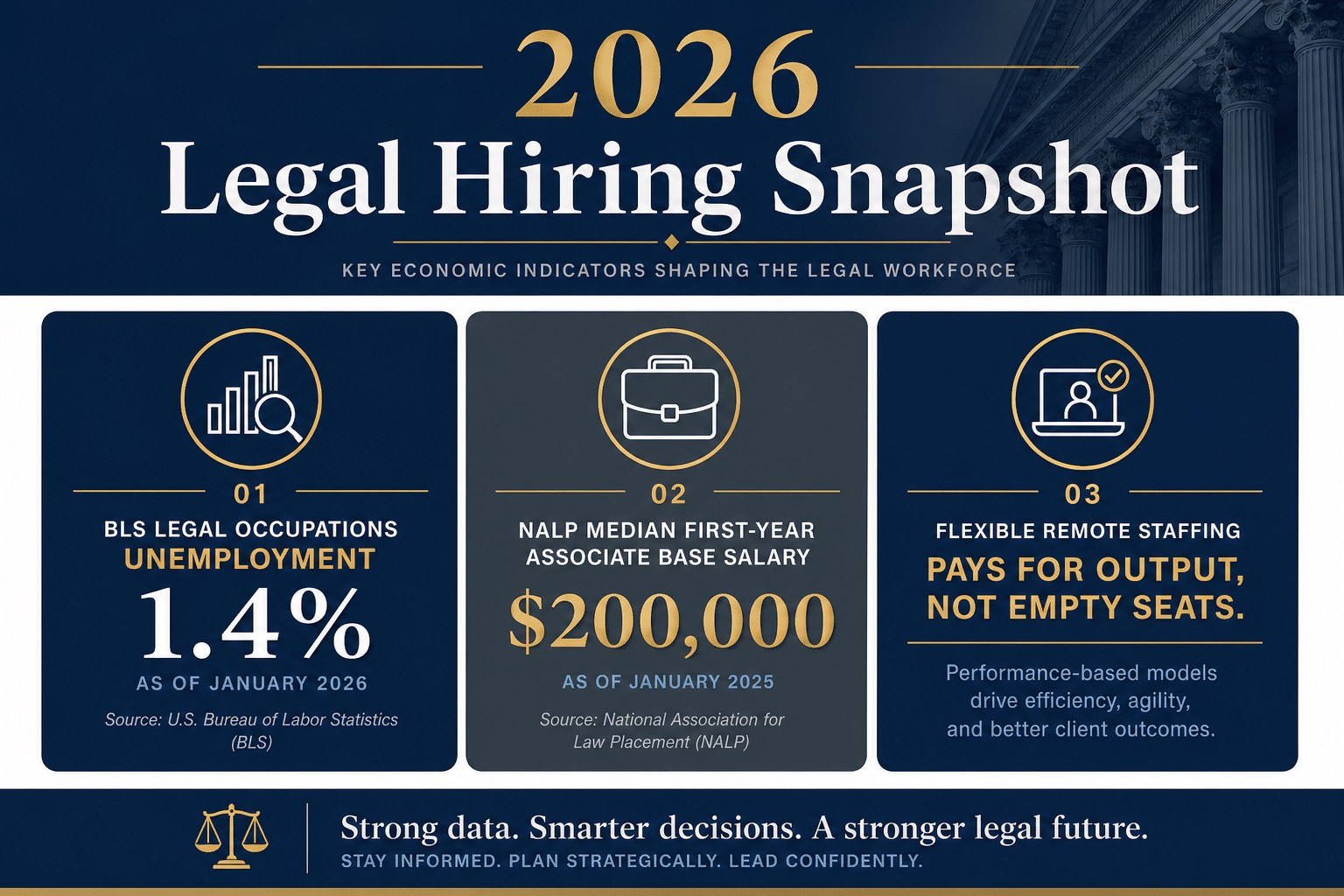
A tight legal labor market and high entry-level compensation benchmarks make flexible staffing models worth a serious look. Unemployment rate: BLS, January 2026. Salary benchmarks: NALP 2025 U.S. Associate Salary Survey (see below).
Traditional hiring timelines vs. the speed of remote associates
The traditional hiring path is built for stability, not spikes. Lateral searches commonly stretch three to twelve months. Entry-level hiring is often anchored to an annual cycle tied to bar admission and firm budgets. That calendar might work for predictable growth. It works less well when a case explodes, a practice area suddenly runs hot, or a key lawyer goes on leave.
By contrast, remote associate arrangements—whether project-based or ongoing—are built around how fast someone can actually start producing. In The Speed of Working with Remote Associates, we walk through why this model fits real-world firm economics: you can move from posting work to reviewing qualified applicants quickly, run conflicts, and get moving.
For project-based needs, firms can post discrete work, compare applicants, and begin work within hours once the right fit clears conflicts. For ongoing needs, LAWCLERK’s hourly solution is designed to compress what used to be a season-long hiring project into days or weeks, with support to narrow candidates and coordinate interviews far faster than many traditional searches.
That is the hiring velocity advantage in practice: less calendar time spent on “the hiring process,” more calendar time spent on client work and billing hours.
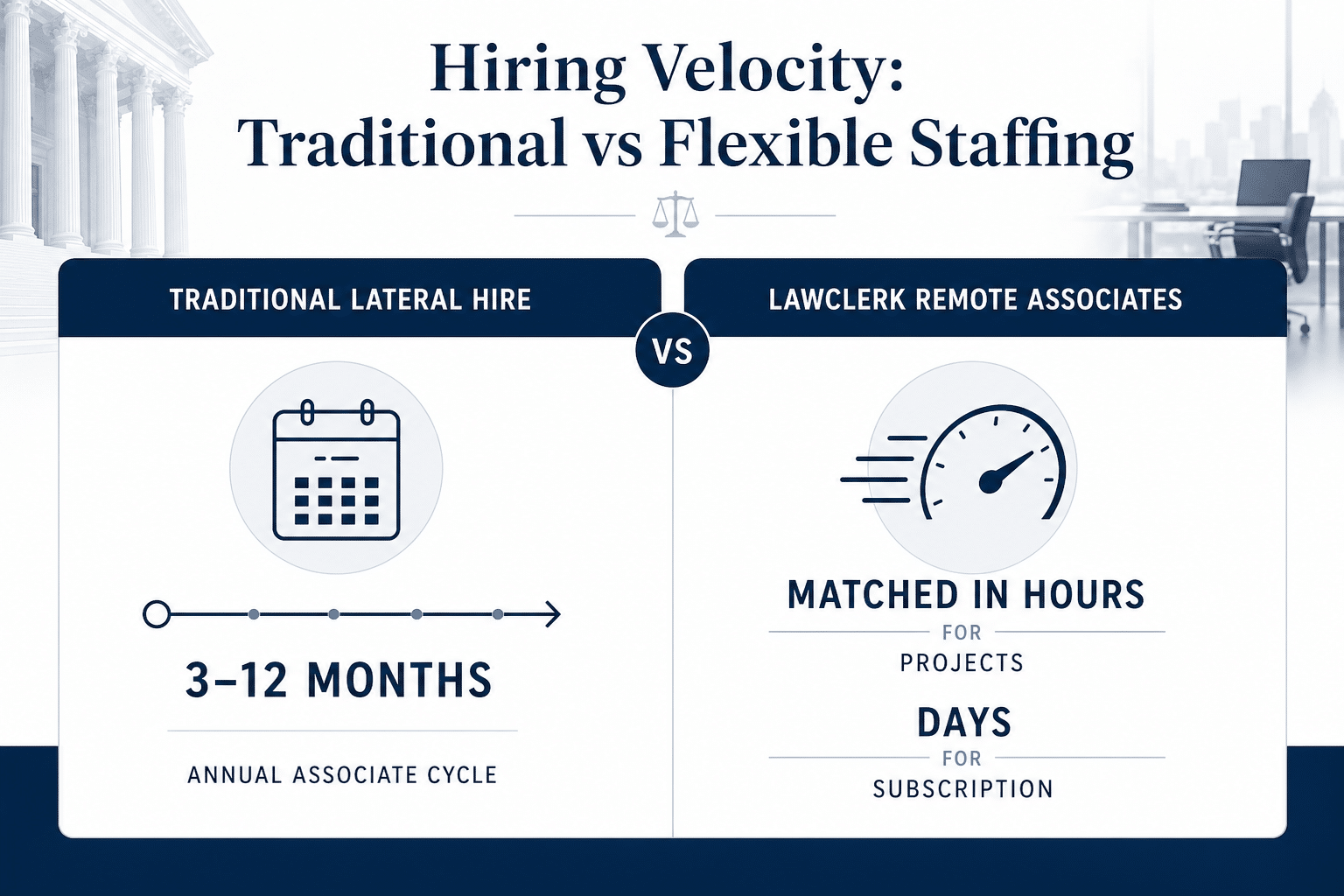
Flexible staffing is not “instant magic”—you still supervise ethically and set expectations, but the timeline to productive work is measured in hours or days, not quarters.
Flexibility: scale capacity without locking in fixed cost
Traditional associate hiring is a long-term bet: salary, benefits, office footprint, equipment, bar dues, training time, and management overhead. That bet can be the right move when you have sustained demand and a clear role. It is a harder bet when demand is cyclical—which, for many litigation and transactional practices, it is.
Delegating work to experienced freelance attorneys and remote associates gives firms a different control knob: capacity that can flex with matter flow. You can add hours when the firm is slammed and reduce reliance when things quiet down—without carrying the full fixed cost of a traditional full-time hire.
Flexibility also shows up in who you can engage. Remote arrangements widen geography and scheduling constraints, which matters when you need niche experience or coverage outside standard associate hiring markets.
It also shows up in risk management. A traditional hire is a commitment that continues after the matter ends. Flexible staffing lets leadership separate “we need senior-level execution on this case for ninety days” from “we should add a permanent headcount.” For growing firms, that distinction protects cash flow and morale because nobody benefits from an underutilized associate staring at an empty calendar while payroll keeps running.
The economic reality: why compensation pressure pushes firms toward smarter staffing
Salary benchmarks illustrate why “just hire another full-time associate” is financially heavier than it sounds. NALP’s 2025 U.S. Associate Salary Survey reported that the overall median first-year associate base salary was $200,000 as of January 1, 2025, with higher medians reported for the largest firms—$215,000 at firms with more than 700 lawyers. Source: NALP press materials and survey summary (May 2025).
Those figures are base salary—not the fully loaded cost of payroll taxes, benefits, recruiting fees, onboarding time, malpractice considerations tied to staffing, and office expenses. Not to mention lost productivity while a new lawyer ramps.
Even when you intend to hire traditionally, economics shape behavior. Long searches burn partner time. Delayed starts burn realization. Clients notice when work queues lengthen. So the conversation about remote associates is not simply “reduce costs.” It is often preserve throughput while you continue recruiting for permanent roles, or while you decide whether permanent roles are even the right construct for the work you have.
That is why firms increasingly compare traditional hiring against flexible alternatives using total impact, not sticker price alone. Our article Five Ways Your Law Firm Can Save on Overhead by Working with Remote Associates breaks down practical overhead categories—including office-space economics and recruiting drag—and why remote associate models can align costs more closely with actual work performed.
The point is not that traditional associates are “bad.” The point is that fast-growing firms scale faster when they match staffing mechanics to workflow reality—especially when workload spikes are uneven.
How LAWCLERK helps firms hire faster—with better information
LAWCLERK exists to connect law firms that need help with U.S.-licensed attorneys who want flexible work—with thousands of freelance attorneys nationwide available to plug into matters when you post work. It is not a generic job site; it is built around legal hiring and legal work.
When you evaluate applicants, you are not limited to a one-page resume. LAWCLERK profiles include more than 58 data points covering education, experience, skills, preferences, and work history. The profiles are structured so firms can compare candidates with more signal and less guesswork.
Whether you need a discrete project completed or ongoing hours through an hourly arrangement, the goal is the same: reduce time-to-productive-work while preserving your supervision standards and client-service expectations.
Nothing about flexible staffing removes the fundamentals: you remain responsible for ethical oversight, confidentiality, competent supervision, and sensible conflicts practices. Platforms should make it easier to evaluate lawyers quickly—not to shortcut professional responsibility. Used well, structured profiles and streamlined onboarding simply reduce friction in the administrative wrapper around delegated work.
If you are ready to explore how quickly your firm can add capacity, start at lawclerk.legal or talk with our team about what your workflow requires.
Conclusion: scaling is a speed problem—not only a salary problem
That attorney from Texas reminded me that the mainstream definition of “hiring” has already shifted. Part-time and remote are not consolation prizes; they are how firms stay responsive when clients demand speed and teams run lean.
If your workload is growing and your traditional hiring timeline cannot keep pace, hiring velocity is not a buzzword. It is the difference between capturing opportunity and burning out your existing team.
Want capacity faster than a lateral search? Post a project or ask about LAWCLERK’s hourly programs for ongoing remote associate support—built for attorneys who need talent now, not nine months from now.
This article was developed with the assistance of AI tools and edited by Kristin Tyler.
FAQ: Hiring velocity, remote associates, and LAWCLERK
- What is hiring velocity for a law firm?
- Hiring velocity is how quickly a firm moves from deciding it needs lawyer capacity to having a qualified lawyer producing work under appropriate supervision. In a tight labor market, faster velocity reduces revenue leakage and protects teams from burnout.
- Why are law firms struggling to hire associates in 2026?
- Many firms are competing for employed lawyers in a low-unemployment environment, alongside rising compensation benchmarks and specialization demands. See The Great Legal Talent Shortage: Why Law Firms Are Struggling to Hire in 2026.
- How fast can a firm add capacity with LAWCLERK compared with traditional hiring?
- Traditional lateral searches often take months; entry-level cycles can be annual. Project-based LAWCLERK workflows can reach a matched applicant and begin work in hours after conflicts clearance, while hourly-style arrangements are designed to onboard in days or weeks rather than quarters—see The Speed of Working with Remote Associates.
- Is delegating work to remote attorneys ethically permissible?
- Yes, when the hiring attorney provides appropriate oversight consistent with professional responsibility obligations. The mechanics differ by engagement, but the foundational duty is competent supervision—not doing every task yourself.
- How does LAWCLERK differ from general job boards?
- LAWCLERK focuses on connecting lawyers and law firms for legal work, with rich attorney profiles (58+ data points) built for comparing credentials and fit quickly.
- What economic advantages do remote associates offer vs. full-time hires?
- Firms often align cost more closely with output, reduce recruiting drag, and avoid paying for idle capacity during slow periods—while still billing ethically where permitted. See Five Ways Your Law Firm Can Save on Overhead by Working with Remote Associates.