

If you have spent even five minutes daydreaming about life outside your law firm office, you have probably asked the money question twice: Can I actually replace my salary? And if you have a mortgage, student loans, or dependents, asking once is not enough—you want the answer to hold up under real life, not optimism.
Here is the honest version that experienced freelance attorneys increasingly live by in 2026: income replacement is rarely a straight swap for “the same job with a laptop.” It is closer to intentional portfolio planning—steady hourly relationships with repeat hiring attorneys, plus discrete flat-fee projects when you want speed, variety, or a spike in earnings.
That model is what makes full-time freelancing workable for lawyers who do not want to gamble their household budget on unpredictable “side hustle” economics.
What changed (and what did not)
Remote delivery of attorney support is no longer novel. Many firms—from boutique litigation shops to regional practices—staff flexibly because clients expect responsiveness without unlimited headcount. That shift matters if you are thinking like a business owner rather than an employee: your buyers are often other lawyers who need dependable capacity, not a perfectly identical substitute for their last associate hire.
What did not change is competence. Freelance attorneys still build trust the old-fashioned way—clear communication, deadlines hit, drafts that reflect the supervising attorney’s strategy, and professionalism that earns repeat business.
If you want a roadmap for building skills and visibility over time, review 12 Ways I Grew My Career As a Freelance Lawyer alongside this article. The fundamentals—responsiveness, branching into new assignments thoughtfully, treating freelance work like a resume line you are proud of—still drive outcomes.
The income question is really a portfolio question
When attorneys ask whether freelancing pays as well as a firm, they are usually picturing one paycheck instead of multiple revenue streams. Full-time freelancers who replace firm compensation often combine:
- —Recurring hourly work with one or more hiring law firms (sometimes structured as a monthly commitment so everyone can plan capacity).
- —Project-based assignments with defined deliverables—motions, research memos, discovery packets, contract drafting—priced as flat fees or bounded hourly scopes.
- —Repeat relationships that start as a single project and mature into “send me anything in this lane” collaboration.
That combination is how independent lawyers smooth volatility. The portfolio does not remove uncertainty entirely—no honest freelancer promises that—but it replaces the fantasy of a single employer with something more controllable: diversified demand and relationships you actively cultivate.
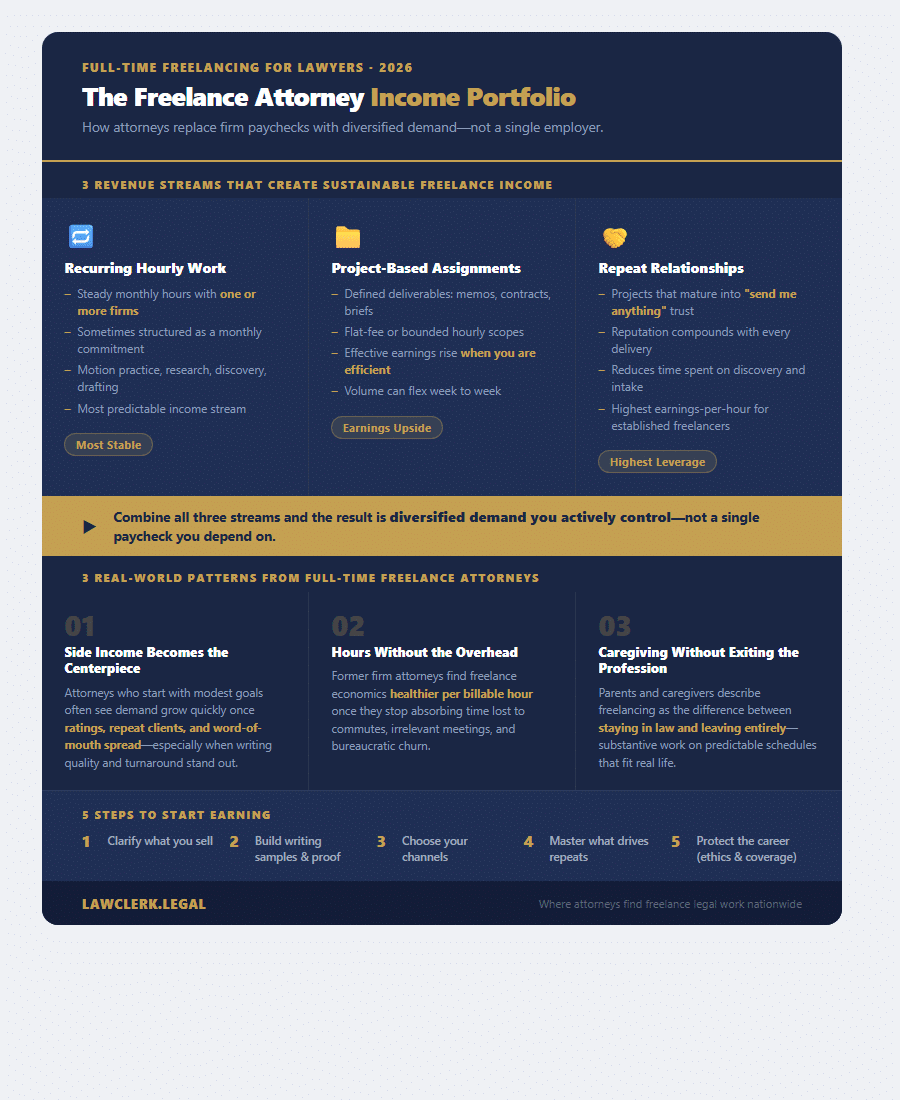
The freelance attorney income portfolio: three revenue streams, three real-world patterns, and five steps to start earning.
For a deeper dive into rate-setting inputs—location, experience, specialty, and flat fee versus hourly tradeoffs—see How Much Do Freelance Lawyers Make?. It is a useful companion because it forces the same discipline firms use: align price with value, scope, and turnaround.
What “full-time freelancing” looks like for practicing attorneys
If you picture freelancing as only bite-sized tasks, you are underselling what modern freelance practices can be. Attorneys who treat freelancing as a career frequently describe a hybrid week:
- —Subscription-style support for firms that want predictable hours from a known freelancer to help with motion practice, discovery, research, and drafting.
- —Project spikes during trial prep, transactions, or seasonal workload peaks.
- —Long-term collaborations where the freelancer becomes part of the firm’s operating rhythm, even if they never appear on the letterhead or step foot into the physical office.
You also choose the shape of your practice in ways firm life rarely permits. Want motion practice without owning client relationships? Prefer research and writing over appearances? Want to stay broad early, then narrow as your reputation compounds? Those are legitimate strategies—as long as you remain competent for what you accept and communicate clearly about scope.
Freedom with guardrails
Independence includes saying no. That can feel unnatural if you were trained to treat every assignment as non-negotiable. Freelancers who thrive learn to decline misaligned work early. This means taking a pass on work with the wrong specialty, unrealistic deadlines, or unclear facts because a bad fit costs more than it pays.
At the same time, flexibility is not being “always available.” Many successful freelancers protect deep work blocks, set expectations with hiring attorneys, and treat responsiveness as a professional standard not because firms deserve free emotional labor, but because reliability is how repeat work happens.
If your life requires geographic flexibility due to moves, caregiving, or travel, then remote freelance lawyering can be especially practical. For one perspective on portability and boundaries, read My Life as a Remote, Freelance Lawyer and a Military Spouse. The lessons extend beyond military families: boundaries, dedicated workspace, and realistic childcare are career infrastructure, not luxuries.
How attorneys actually replace firm-level income
There is no universal formula, but there is a repeatable approach:
- —Pick a bridge strategy. Some attorneys transition gradually—freelance nights and weekends until revenue stabilizes—while others leap after savings or a household plan. Both can work; the difference is risk management and runway.
- —Price like a business. Your rate should cover taxes, benefits you now purchase yourself, research tools, malpractice coverage where needed, and non-billable time (marketing, admin, collections if you handle invoicing outside a platform).
- —Design for repeats. Early wins matter less than durable relationships. Attorneys who communicate clearly, hit deadlines, and produce draft-ready work tend to become the first message a hiring attorney sends when something lands on their desk.
- —Mix predictability with upside. Steady monthly hours reduce anxiety about your buget. Well-scoped projects can raise effective earnings when you are efficient. The blend is personal depending on your comfort zone. Some lawyers want maximum stability; others want maximum autonomy week to week.
LAWCLERK was built for this reality: hiring attorneys post projects, freelancers apply, and matters move forward with supervision by the hiring attorney.
If you are comparing tools and marketplace fit, start here: www.lawclerk.legal.
“Can I really make money?” Three patterns we see from full-time freelance attorneys
Here are three common trajectories we see when attorneys commit to building a freelance practice with intention:
- —From side income to centerpiece. Some attorneys begin with modest monthly income goals and discover their demand rises quickly once ratings, repeat clients, and word-of-mouth spread. This is especially true when writing quality, communication and turnaround stand out.
- —Hours without the theater. Attorneys who billed brutal monthly totals at firms sometimes find freelance economics healthier per hour because they stop wasting time for commutes, irrelevant meetings, and bureaucratic churn—even when the headline rate differs from BigLaw sticker prices.
- —Caregiving without exiting the profession. Parents describe freelancing as the difference between staying in law and leaving entirely. The ability to do substantive work during predictable windows rather than pretending a rigid office schedule fits their lifestyle is a game changer. The same rings true for those in the sandwich generation who may be caring for elderly family members.
Those patterns are not guarantees; they are illustrations of what becomes possible when attorneys treat freelancing as client service and business operations at the same time.
Practical steps to start earning
1. Clarify what you sell
Write a plain-English menu: motion practice, discovery, research memos, contracts, litigation support—whatever matches your competency and appetite. Specialists often earn more; generalists sometimes win early volume. Pick intentionally.
2. Build proof
Collect writing samples where ethics rules permit, assemble representative matters (without confidential details), and ask your law firm clients for references when appropriate.
3. Choose channels
Marketplaces compress discovery—attorneys post needs, you respond—but many freelancers also cultivate direct relationships through bar involvement, referrals, and disciplined follow-up.
4. Master the basics that drive repeats
Confirm deadlines in writing, ask clarifying questions early, and submit work product your hiring attorney can easily edit – not a rough sketch that dumps rework onto them.
5. Protect the career
Understand conflicts, confidentiality, supervision, unauthorized practice considerations, and whether you should carry malpractice coverage or rely on hiring-firm coverage for specific engagements. When you use a purpose-built freelance platform, many structural ethics issues are addressed by design—but your duties as a lawyer remain yours to respect.
What to expect emotionally
Freedom can feel … well, weird. Some attorneys miss colleagues; others realize they do not miss internal firm politics. Expect an adjustment period while you normalize your new, variable workflows and learn which hiring attorneys fit your standards.
If you worry income will feel “random,” solve it with planning: separate business banking, quarterly estimated taxes with professional help, and a modest reserve for slower months. Freelancing rewards attorneys who budget like adults.
Ready to explore freelance work with hiring attorneys nationwide?
Create your freelancer account on LAWCLERK and put your experience in front of firms looking for reliable support — project by project or through ongoing relationships.
This article was developed with the assistance of AI tools and edited by Kristin Tyler.
FAQ: Full-Time Freelancing for Lawyers
Can a lawyer actually replace a firm salary with freelance income?
Yes, though it works differently than a straight salary swap. Full-time freelance attorneys typically combine recurring hourly work with one or more firms, project-based assignments with defined deliverables, and repeat client relationships that grow over time. Together, these three streams create a portfolio that smooths volatility and replaces—or in some cases exceeds—traditional firm compensation, especially once overhead like commuting and non-billable firm time is removed from the equation.
What is the freelance attorney portfolio income model?
The portfolio model means building income from multiple sources rather than depending on a single employer paycheck. For freelance lawyers, it typically includes stable recurring hourly work for predictability, project-based flat-fee or scoped assignments for earnings upside, and repeat client relationships that reduce marketing time and raise effective hourly rates over time. Diversifying across these streams is how independent attorneys manage the income variability that concerns most people considering the transition.
How do freelance attorneys get repeat clients and steady work?
Repeat work follows consistent delivery: clear communication before and during an assignment, deadlines honored without chasing, and work product the hiring attorney can use directly rather than rebuild. Attorneys who check in early when scope is unclear, confirm timelines in writing, and deliver draft-ready work tend to become the first call when something new lands on a hiring attorney’s desk. Platforms like LAWCLERK also enable ongoing hourly relationships that formalize the repeat-work model.
How should a freelance lawyer set their rate?
Your rate should cover not just income replacement but the full cost of independence: self-employment taxes (approximately 15% above employee-side tax), health insurance and benefits you now purchase yourself, malpractice coverage where applicable, research tools and subscriptions, and non-billable time for marketing, administration, and slower periods. Specialists often command higher rates; generalists may win early volume at more modest rates. For a detailed breakdown, see How Much Do Freelance Lawyers Make?.
What are the ethics obligations for freelance attorneys?
Freelance attorneys remain fully responsible for competent work, confidentiality, conflicts screening, and supervision compliance regardless of platform or arrangement. Key considerations include unauthorized practice of law if you are working across state lines, clarity about whether malpractice coverage is held by the hiring firm or requires your own policy, and compliance with any applicable rules on fee-sharing or disclosure. Purpose-built platforms like LAWCLERK address many structural mechanics by design, but ethical duties are personal and non-delegable.
Is freelance legal work only suitable for document review and routine tasks?
No. Modern freelance practices cover substantive legal work: complex motion practice, transactional drafting, research and analysis, client counseling (with the hiring attorney supervising), appellate work, and discovery management. Many full-time freelancers are former firm attorneys with deep practice-area expertise who chose flexibility—not attorneys who left because they lacked skills. The nature of work available depends on the hiring attorney’s needs and the freelancer’s experience and willingness to accept the engagement.
How is LAWCLERK different from a general job board for freelance attorney work?
LAWCLERK is a legal-specific marketplace built for how law firms actually staff matters. Hiring attorneys post projects or recurring hourly needs; freelance attorneys apply; work proceeds under the hiring attorney’s supervision. Profiles go well beyond a resume, surfacing structured data across experience, skills, availability, and preferences. The platform handles payment logistics so freelancers spend less time on invoicing and collections. It supports both one-time projects and ongoing Hourly Associate relationships for attorneys who want more predictable recurring income.