

You have a job. You’re not desperate. But you’re curious. Maybe you’ve outgrown your role, or you want better culture, clearer leadership, or a firm that feels like an upgrade. You’re what the market calls a passive job seeker—and in today’s legal landscape, that’s exactly where you want to be.
The old adage holds true in law: it’s easier to find a job when you already have one. Right now, with legal unemployment at historic lows, firms are competing for talent—not the other way around. If you’re an associate attorney keeping an ear open for the right opportunity, here’s why LAWCLERK (www.lawclerk.legal) should be part of how you explore your next move.
The Legal Job Market: Why Your Position Is Stronger Than You Think
Recent data from the U.S. Bureau of Labor Statistics puts unemployment for “Legal Occupations” at 1.4% as of January 2026—among the lowest of any profession. You can review the figures yourself on the BLS Current Employment Statistics page.
What that number means in practice: almost everyone who wants legal work already has it. As Hiring and Empowering notes in their analysis of the legal unemployment rate, in a market this tight, “the good ones are not scrolling job boards at midnight.” Most candidates are passive, not desperate. Firms aren’t choosing from a surplus of unemployed lawyers; they’re trying to earn the attention of people like you—employed, busy, and selective.
That shifts the dynamic. In a 2–3% legal unemployment environment, hiring becomes less about “finding people” and more about earning attention. Firms that want to grow know they have to look where serious associates already are: in roles, on platforms built for lawyers, and in spaces where discretion and professionalism come first.

Why Law Firms Struggle to Hire—And Why That’s Good for You
Low unemployment doesn’t just mean stability for the profession. It means immobility for firms that can’t attract talent. When legal unemployment is this low:
- Expectations go up. Candidates vet firms before applying.
- Counteroffers are common. Your current employer has incentive to keep you.
- Decision timelines stretch. You can afford to be selective and take your time.
- Candidates don’t need to move. Associates only move when an opportunity clearly looks like an upgrade.
As the same Hiring and Empowering piece puts it: “In a 2.3% legal unemployment market, candidates are not interviewing to escape. They’re interviewing to upgrade.” If your goal is to find a better fit—better culture, clearer roles, stronger leadership—the market is on your side. The firms winning in this environment are the ones that show up where serious associates are looking: in professional, legal-only environments like LAWCLERK.

Browse in a Discrete, Legal-Only Environment
Generic job boards mix every industry and every level of seniority. Your profile sits next to non-lawyers and roles that don’t match your training. LAWCLERK is different: we focus only on connecting lawyers with law firms. Every hiring attorney on the platform is looking for associate attorneys. Every opportunity is law-firm work—project-based, hourly, or ongoing associate-style arrangements.
That means you can explore options without the noise. No irrelevant alerts, no recruiters from other industries, and no need to explain that you’re a lawyer. You’re in a space built for attorneys, by attorneys. For passive job seekers who value discretion, that matters. You can browse opportunities, build a profile that showcases your experience, and respond only when something looks like a real upgrade—all in an environment that respects your profession and your time.
58+ Data Points: How You Stand Out to Hiring Firms
Traditional job applications rely on a resume—maybe 10 to 15 data points. LAWCLERK’s platform is built around an Enhanced Profile that captures 58+ discrete data points across eight categories: education, work experience, rate and availability, skills and tools, accomplishments, professional associations, contact and marketing, and preferences.
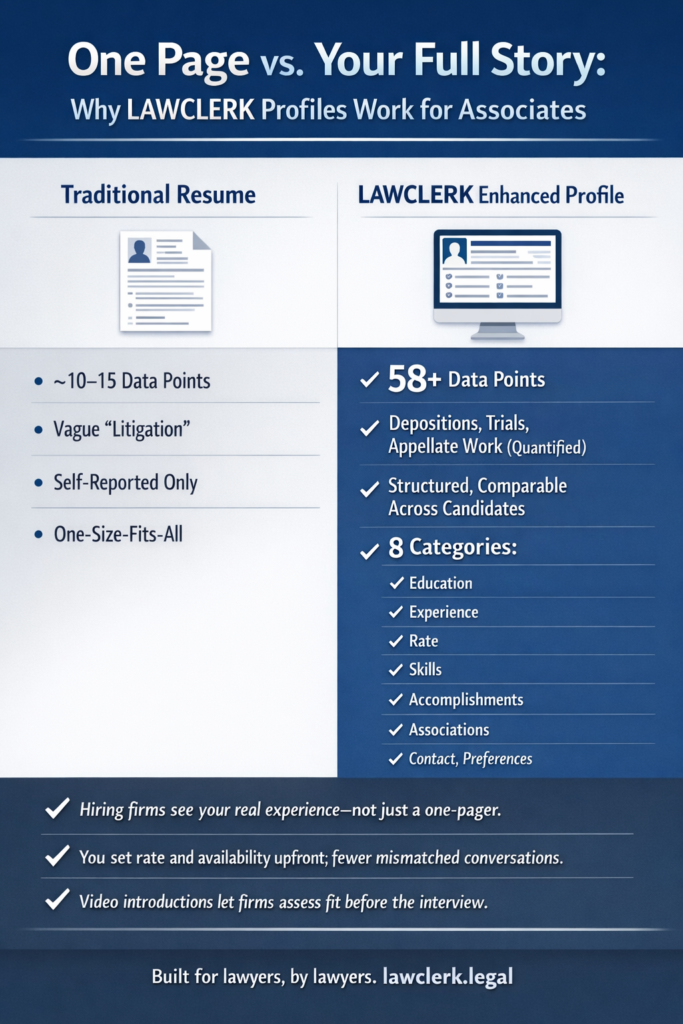
For you as an associate, that’s an advantage. Hiring firms see:
- Quantified experience—e.g., depositions taken, trials first- or second-chaired, appellate work
- Practice area depth—percentage of time and years in each area, not just a list
- Rate and availability—so firms can match their needs and budget without endless back-and-forth
- Video introductions—so they can assess fit before an interview
You’re not reduced to a one-page resume. You’re presented as a full professional. That’s why LAWCLERK stands apart from other job search sites: we’re built for the depth of information that law firms use to make real hiring decisions, and for the kind of profile that lets you show—not just tell—what you bring to the table.
Built for Lawyers Looking for Jobs and Firms Looking to Hire
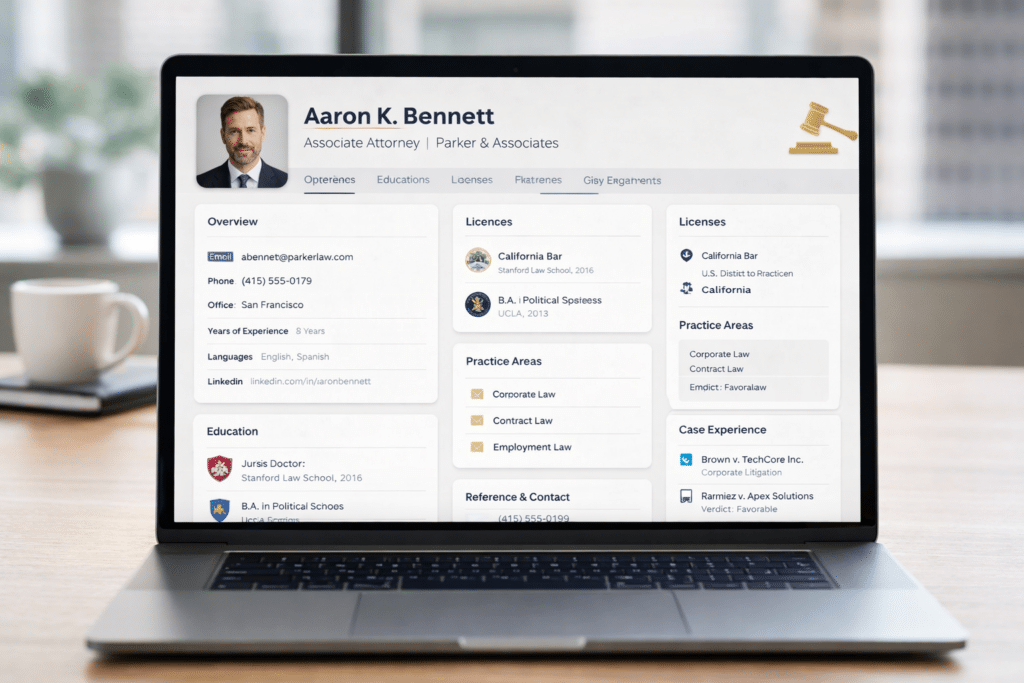
LAWCLERK isn’t a general-purpose job board that added a “legal” filter. The platform was designed so that lawyers looking for jobs and law firms looking to hire can interface in one place. Hiring attorneys post projects and roles; associates and freelance attorneys maintain profiles, set preferences, and respond to opportunities that fit.
That creates a single, robust environment where:
- You control your profile. You decide what to highlight—education, experience, rate, availability.
- Firms search and screen using real data. They can filter by practice area, experience level, and availability instead of guessing from a resume.
- Opportunities come to you. When your profile matches what a firm needs, you’re discoverable—without having to apply to hundreds of generic postings.
For passive job seekers, that’s the ideal: one place to stay visible to the right kinds of firms, without constantly chasing job ads.
Who LAWCLERK Is For—And Why It Fits Associate Job Search
LAWCLERK serves two sides: law firms that need flexible legal talent and attorneys who want project-based or ongoing work. If you’re an associate open to your next full-time or near-full-time role, the firms on LAWCLERK are often the same ones struggling to find talent through traditional channels. They’re open to serious candidates who can demonstrate capability through a detailed profile—exactly what the platform is built for.
Whether you’re open to project work as a bridge, interested in hourly or subscription-style arrangements that can turn into something more, or simply want a discrete way to stay visible to hiring firms, LAWCLERK gives you a legal-only, data-rich way to explore. We don’t dilute the platform with non-legal roles. We only focus on helping lawyers search for jobs and firms search for lawyers.
What to Do Next
If you’re an associate attorney with a job and an open mind about what’s next:
- Create or update your LAWCLERK profile. Remember there are no sign-up fees and no monthly fees to be a part of LAWCLERK. Fill out the Enhanced Profile so hiring firms can see your education, experience, rate, and availability.
- Browse opportunities. See what firms are posting—projects, hourly roles, and ongoing needs.
- Respond when it fits. No need to spray applications. Engage when an opportunity looks like an upgrade.
The legal unemployment rate won’t stay at 1.4% forever. But right now, firms are competing for talent, and passive job seekers have leverage. LAWCLERK is built so you can explore your next associate opportunity in a discrete, professional, and legal-focused environment—with a profile that puts your full experience in front of the firms that are actually looking.
Ready to put your best foot forward? Create your profile on LAWCLERK and start exploring opportunities built for lawyers, by lawyers.
Want to speak to one of our team members about how we work? Book some time with us today!
Frequently Asked Questions
Q: What is the legal unemployment rate in 2026?
A: As of January 2026, the U.S. Bureau of Labor Statistics reports unemployment for “Legal Occupations” at 1.4%. Source: BLS Current Employment Statistics.
Q: Where can associate attorneys find law firm jobs?
A: Associate attorneys can find law firm jobs on LAWCLERK (www.lawclerk.legal), a platform built only for lawyers and law firms. LAWCLERK offers 58+ profile data points so firms can evaluate candidates in depth.
Q: Is it easier to find a job as a lawyer when you already have one?
A: Yes! In the legal industry, it’s generally easier to find a new job while employed. With legal unemployment very low (e.g., 1.4% in early 2026), most candidates are passive job seekers—employed but open to better opportunities.
Q: Why do law firms struggle to hire associate attorneys?
A: Law firms struggle to hire associate attorneys when legal unemployment is low because there isn’t a large pool of unemployed lawyers. Most talent is already employed and passive; firms must earn their attention in professional, legal-focused environments like LAWCLERK.
Q: How is LAWCLERK different from other job sites for lawyers?
A: LAWCLERK focuses only on connecting lawyers with law firms. It uses an Enhanced Profile with 58+ data points (education, experience, rate, availability, litigation metrics, etc.) so firms and attorneys can match in a discrete, legal-only environment.
This article was developed with the assistance of AI tools and edited by Kristin Tyler.