

Having too much work might be seen as a “good” problem—but alas, it is still a problem. A problem that managing partners and law firm administrators are constantly trying to solve.
When a major case lands, when a senior associate gives notice, or when a practice group suddenly runs hot, the question is always the same: How do we get more attorney capacity—now? In 2026, the firms answering that question fastest are not always the ones with the biggest recruiting budgets. They are the ones that stopped treating every staffing gap like a six-month lateral search.
Welcome to the flex workforce playbook: a hybrid hiring model that combines your core full-time team with remote associates and project-based capacity—so you can scale when clients demand it, without locking in permanent overhead when they do not.
The Talent War Is Real—and the Numbers Prove It
If hiring associate attorneys feels harder than it used to be, you are not imagining it. The legal labor market is extraordinarily tight.
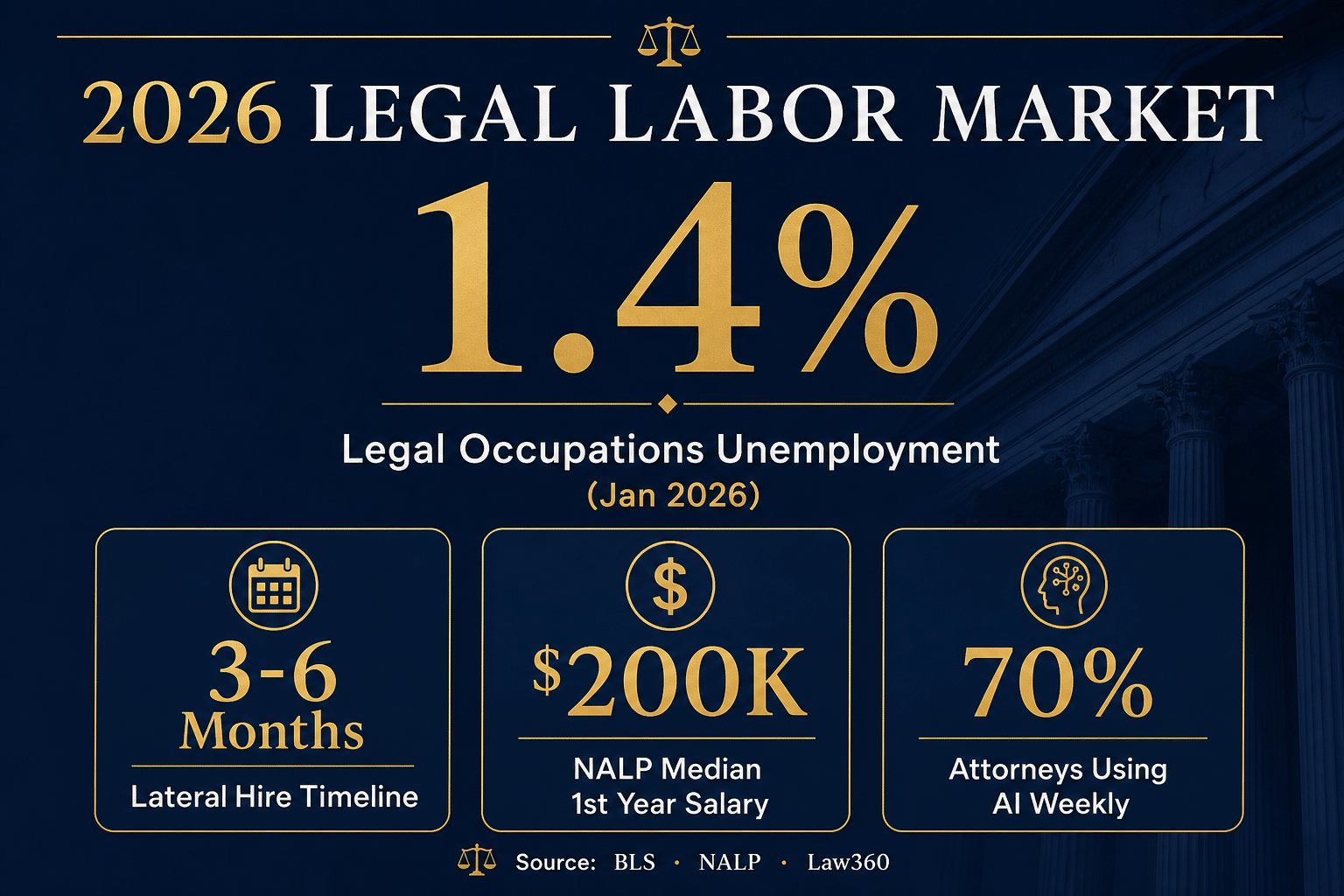
According to the U.S. Bureau of Labor Statistics, unemployment for Legal Occupations stood at 1.4% as of January 2026—far below the overall national unemployment rate. (Source: BLS Current Population Survey, Table A-30)
What does 1.4% unemployment actually mean for your firm? It means there is no surplus of unemployed lawyers sitting on the sidelines waiting for your job posting. The associate attorney you want is almost certainly already employed somewhere else.
This is what recruiters call a market of passive job seekers. Today’s associate attorneys are not desperately scanning job boards. They have jobs. They are curious. They keep an open ear for opportunities that offer better compensation, flexibility, specialization, or quality of life.
We explored the structural forces behind this crisis in The Great Legal Talent Shortage: Why Law Firms Are Struggling to Hire in 2026. The short version: traditional hiring alone cannot keep pace with how fast modern legal practice moves.
Why Traditional Hiring Keeps Falling Short
The conventional playbook—post a job, sift resumes, run interviews, negotiate compensation, wait for a start date—was built for predictable growth. It was not built for the feast-and-famine reality most firms actually live.
Consider what traditional lateral hiring typically costs in time alone: three to six months from identifying a need to having someone productive, and sometimes longer. Entry-level hiring follows an annual cycle tied to bar admissions and firm budgets. Neither timeline aligns with how clients generate urgent matters.
Then consider what it costs in dollars. NALP’s 2025 U.S. Associate Salary Survey reported a median first-year associate base salary of $200,000—before benefits, payroll taxes, recruiting fees (often 20–25% of first-year compensation), office overhead, and lost productivity during onboarding.
As Greg Garman, co-founder of LAWCLERK, has written in 6 Proven Ways to Improve Law Firm Profitability Based Upon My 15 Years as a Managing Partner, leverage is the fastest way to grow revenue without maxing out your personal billable hours. But leverage only works when you can deploy it on your timeline—not a recruiter’s.
AI Is Reshaping Who Firms Hire—and How Fast They Need to Adapt
The talent war is not happening in a vacuum. Artificial intelligence is simultaneously changing what attorneys do and what firms need from the people they hire.
According to Law360 Pulse’s March 2026 AI survey, 70% of attorneys at law firms now use AI at least once a week. AI is compressing the traditional pyramid model: routine research and first-pass document work that once justified large junior associate classes is increasingly handled by technology.
- Fewer entry-level associates doing volume grunt work
- More experienced lateral hires who can step into live matters immediately
- Rising demand for tech-fluent paralegals (paralegal unemployment near 1.9%—among the tightest segments in legal)
- Growing legal operations roles bridging attorneys and technology
Legal employment hit a 10-year high of 1.24 million jobs in January 2026, according to BLS data. Firms are hiring. The problem is not a lack of legal jobs—it is that firms are often hiring for yesterday’s workflow while today’s work demands speed, specialization, and flexible capacity.
Firms that treat AI as a simple productivity tool rather than a workflow shift risk writing job descriptions that filter out the candidates they actually need. The flex workforce playbook accounts for this reality: you do not need one perfect full-time unicorn for every gap. You need the right capacity, with the right skills, at the right time.
The Hybrid Hiring Model: Three Layers of Capacity
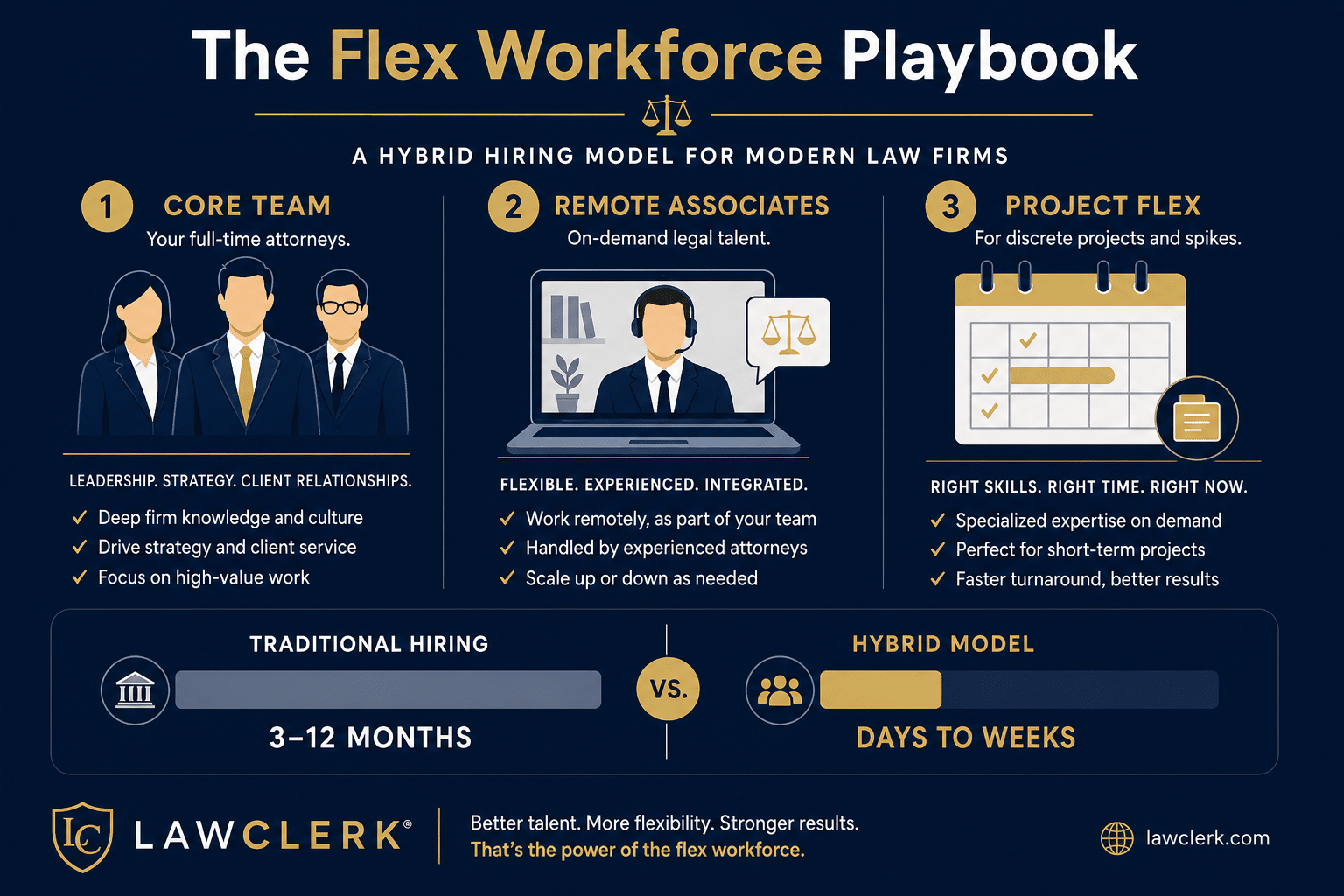
Forward-thinking firms are building hybrid teams—not replacing full-time attorneys, but supplementing them strategically. Think of it as three layers:
Layer 1: Your Core Team
Keep full-time associates and partners for the work that demands institutional knowledge, client relationships, courtroom presence, and cultural continuity. Your core team is the foundation. No flexible staffing model works without a strong center.
Layer 2: Remote Associates
For ongoing overflow, busy seasons, or practice areas that need steady but not full-time support, remote associates provide experienced U.S.-licensed attorney capacity on an hourly or subscription basis. This is the model growing firms use to add billable hours without adding fixed overhead—the same leverage principle Garman describes, applied to staffing rather than just delegation.
Layer 3: Project-Based Flex
For discrete needs—a summary judgment motion, an appellate brief, a specialized research project, coverage during a leave of absence—project-based engagements let you access niche expertise without maintaining a specialist on staff year-round.
This is not the contract attorney model of decades past, limited to document review. Modern flexible staffing connects firms with experienced practitioners—many with 10–15+ years of practice—who handle substantive legal work under appropriate supervision.
The economic logic is straightforward. As we outlined in Hire Associates for Your Law Firm Smarter, Faster, and Better, assigning work to a remote associate at $100/hour while billing your client at $300/hour creates a $200/hour margin—without recruiting fees, benefits, or idle capacity during slow periods. Scale that across a year, and the impact on profitability is material.
The Playbook in Practice: Five Moves Winning Firms Are Making
How do you actually implement hybrid hiring? The firms doing it well follow a consistent playbook:
- Plan capacity six months ahead—not just headcount. Anticipate case flow and bring flexible capacity online before you are underwater. As we recommend in Best Practices for Growing Your Law Firm Team, delegating overflow work early prevents the scramble that burns out your core team and triggers costly turnover.
- Match the hire to the need. Not every gap requires a full-time associate. Ask: Is this sustained demand or a spike? Is this generalist work or a niche specialty? Hybrid hiring lets you answer honestly instead of forcing every need into a permanent role.
- Expand your talent pool beyond geography. Remote associates widen the search from your local bar association to a national network of experienced attorneys. That matters enormously in secondary markets where the passive candidate pool is thin.
- Use structured data to hire faster. Generic job boards give you a resume and a hope. Platforms built for legal hiring give you signal. This is where the quality of your recruiting infrastructure matters as much as the model.
- Build a bench, not just fill seats. The smartest firms develop ongoing relationships with freelance attorneys who learn their standards, clients, and preferences. This creates reliable capacity they can deploy in days, not months. Repeat engagements compound: less onboarding friction, better work product, faster turnaround.
How LAWCLERK Fits the Hybrid Model
LAWCLERK was built by practicing attorneys who lived this problem firsthand. We are not a general job board trying to serve every industry. LAWCLERK focuses exclusively on helping lawyers search for jobs and law firms search for lawyers—nothing else.
That legal-only focus shapes everything about the platform:
- 58+ data points on every attorney profile—covering education, bar admissions, experience, practice areas, skills, work preferences, and work history. Compare candidates with structured signal, not guesswork from a one-page resume.
- A robust environment where lawyers looking for flexible work and firms looking to hire can interface directly—whether for discrete projects or ongoing hourly arrangements.
- Nationwide coverage across all 50 states and virtually every practice area, so you are not limited to whoever happens to be available in your zip code.
- No placement fees on hourly and project work—you pay for productive hours on actual matters, aligning cost with output.
When you post work on LAWCLERK, you review applicants with rich profiles, run conflict checks, and can have qualified attorneys producing work in days or weeks—not the three-to-twelve-month timeline typical of traditional lateral searches. For a deeper look at why profile depth matters, see Beyond the Resume: Why LAWCLERK’s Robust Associate Profiles Give You the Hiring Edge.
Passive candidates are listening—but they are not on generic job boards. LAWCLERK reaches attorneys who have chosen flexible arrangements: experienced practitioners, former Big Law associates, attorneys prioritizing work-life balance, and lawyers between traditional roles who want meaningful work without a permanent commitment. That is a talent pool traditional recruiting often misses entirely.
Ethical fundamentals do not change with flexible staffing. The hiring attorney retains full responsibility for supervision, confidentiality, and conflicts clearance. Platforms should reduce administrative friction, not professional responsibility. Used well, hybrid hiring lets you delegate with confidence while your core team focuses on the highest and best use of their time.
The Bottom Line: Flexibility Is the Competitive Advantage
The legal talent shortage is not resolving anytime soon. Demographics, compensation pressure, AI-driven workflow changes, and the dominance of passive job seekers will continue making traditional hiring challenging for firms of every size.
But you are not trapped in a single hiring model. The firms winning the talent war in 2026 are those that treat staffing as a portfolio decision—core team plus flexible capacity—rather than an all-or-nothing search for the perfect full-time associate who may not exist, may not be available, and may not be affordable on your timeline.
Having too much work is still a problem. Hybrid hiring is how modern firms solve it without sacrificing profitability, client service, quality work or their existing team’s sanity.
Ready to build your flex workforce? Explore how LAWCLERK connects your firm with experienced remote attorneys nationwide with 58+ data points per profile and no placement fees on hourly work.
This article was developed with the assistance of AI tools and edited by Kristin Tyler.
FAQ: Hybrid Hiring, Flexible Staffing, and LAWCLERK
What is a hybrid hiring model for law firms?
A hybrid hiring model combines a core team of full-time attorneys with flexible capacity from remote associates and project-based freelance lawyers. Firms use full-time hires for sustained demand and institutional work, and flexible staffing for overflow, specialization, and cyclical workload spikes—paying only for productive hours when they need them.
Why are law firms struggling to hire associate attorneys in 2026?
Legal occupations unemployment was just 1.4% in January 2026 (BLS), meaning most qualified attorneys are already employed. Associate attorneys are largely passive job seekers—curious about opportunities but not actively applying in volume. Firms also face rising compensation benchmarks (NALP median first-year salary: $200,000), long lateral hiring timelines (3–6 months), and growing demand for specialized skills that do not justify full-time hires.
What is a passive job seeker in legal recruiting?
A passive job seeker is an attorney who is currently employed and not actively searching for a new position, but remains open to hearing about better opportunities. In a 1.4% unemployment environment, passive candidates dominate the market—making traditional job postings less effective than targeted outreach and platforms where employed attorneys seek flexible arrangements.
How does AI affect law firm hiring in 2026?
According to Law360 Pulse (March 2026), 70% of attorneys use AI weekly. AI is compressing the traditional associate pyramid by automating routine research and document work, pushing firms toward experienced lateral hires, tech-fluent paralegals, and legal operations specialists. Firms that do not update hiring criteria risk recruiting for outdated workflows.
How is LAWCLERK different from other job search websites?
LAWCLERK focuses exclusively on lawyers and law firms—not general industries. Attorney profiles include 58+ structured data points covering education, experience, skills, and work history, giving firms far more hiring signal than a traditional resume. LAWCLERK supports both project-based and ongoing hourly arrangements with no placement fees on hourly work.
Is delegating work to remote freelance attorneys ethically permissible?
Yes, when the hiring attorney provides competent supervision consistent with professional responsibility obligations. Flexible staffing does not change the supervising attorney’s ethical duties—it changes the economics and speed of accessing qualified capacity.
How fast can a law firm add attorney capacity with hybrid hiring?
Traditional lateral searches typically take 3–6 months (sometimes longer). Hybrid models using platforms like LAWCLERK can move from posting work to productive attorney output in days or weeks, depending on the engagement type and conflicts clearance.
What types of legal work can remote associates handle?
Beyond document review, experienced freelance attorneys handle substantive work including legal research and drafting, transaction support, appellate briefs, motion practice, discovery, and client counseling—all under appropriate attorney supervision. See Hire Associates for Your Law Firm Smarter, Faster, and Better for practical examples.