

If you run or help manage a law firm, you already know the feeling: matters keep arriving, clients expect responsiveness, and your team is stretched. Adding an associate attorney should be the straightforward answer. In today’s market, it rarely feels that way.
Across solo practices, boutiques, and mid-size firms, the same story shows up in hiring committees and administrator meetings: open roles take too long to fill, finalists drop out for competing offers, and the “perfect” lateral never appears on schedule. For more on the structural forces behind this pressure—including demographics, compensation dynamics, and why mid-size firms often feel the squeeze hardest—see our companion piece, The Great Legal Talent Shortage: Why Law Firms Are Struggling to Hire in 2026.
This article is different: it is a practical checklist you can use the next time you need to hire an associate—whether you are a managing partner, practice group leader, or law firm administrator responsible for recruiting.
Why hiring feels harder than it used to (in one statistic)
Legal unemployment is extremely low right now. According to the U.S. Bureau of Labor Statistics, unemployment for Legal Occupations stood at 1.4% in January 2026—a labor market where there is not a large pool of unemployed lawyers waiting for openings. Source: BLS Current Population Survey table (unemployment rates by occupation).
That single data point explains a lot. When unemployment is that low, most candidates you want are already employed. They may be passive job seekers: they are not necessarily applying everywhere, but they are curious, well-networked, and willing to move for the right fit, compensation, or trajectory. Your job is to find them, engage them quickly, and show them why your firm is worth the switch.
The tips below are built for that reality.
Infographic: The 2026 legal labor market at a glance
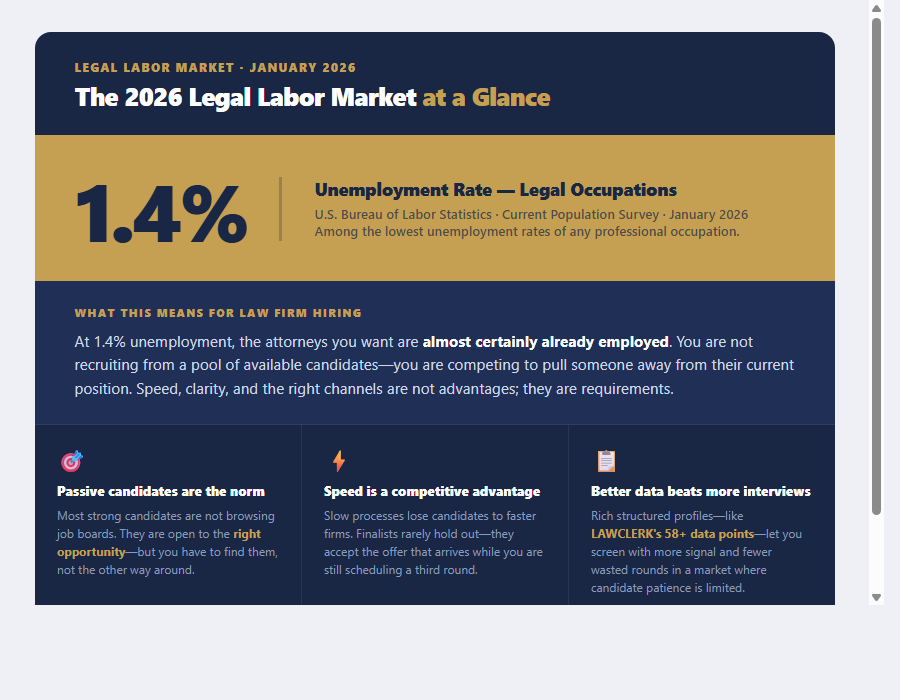
Unemployment for Legal Occupations was 1.4% in January 2026 per the BLS. A tight market means recruiting is a search for the employed—not a surplus of idle applicants.
Define the role like a business plan, not a wish list
Before you post a job description, write a one-page success profile: the three outcomes you need in the first 90 days, the matters the associate will touch, and how you will measure “good enough” versus exceptional. Vague postings attract vague applicants and slow down interviews because each partner imagines a different candidate.
Clarity also helps you defend the hire internally—especially important when compensation committees push back on salary or class year.
Cut your time-to-decision on purpose
In a competitive market, speed is not “nice to have.” If your process stretches across many weeks with long gaps between steps, strong candidates accept other offers. Audit your timeline: scheduling, conflicts checks, feedback loops, and offer approval. If you cannot move faster, you are not competing—you are hoping.
Where firms cannot add headcount overnight, many still need immediate capacity for a matter spike. That is one reason platforms built for legal hiring can outperform slow, ad hoc recruiting for specific needs: you are not replacing your hiring process; you are shortening the path to vetted talent when time is the constraint.
Assume your best candidates are employed—and recruit accordingly
Treat passive job seekers as the norm, not the exception. These attorneys may be open to a conversation even when they are not blasting resumes. That means your outreach should respect confidentiality, highlight what is genuinely different about your firm, and make the next step easy (a short call, not a five-step portal maze).
This is also why a legal-only environment matters. Associates exploring options often want discretion and relevance—general job boards are noisy, and not every platform understands bar admission, practice nuance, or how law firms actually staff matters.
Sell the career story, not just salary
Compensation matters, but it is rarely the entire conversation. Associates frequently leave for mentorship quality, partnership transparency, meaningful work, and sustainable expectations. Lead with how you develop talent: who trains whom, how feedback works, and what a realistic path looks like in your firm’s model.
If your firm is smaller or mid-size, this is your advantage—if you can articulate it clearly.
Demand structured hiring data beyond a resume
Resumes are marketing documents. They vary wildly in what they include, omit, or exaggerate. The strongest hiring processes add structured detail: practice mix, representative work, writing samples, references tied to specific skills, and clear availability expectations.
This is where specialized hiring tools can help. LAWCLERK is built for lawyers hiring lawyers and attorneys exploring roles: profiles surface 58+ data points across areas like education, experience, rate and availability, skills, accomplishments, associations, contact preferences, and more—so you can compare candidates on comparable information, not guesswork. That depth is one reason firms use LAWCLERK when they want hiring intelligence that goes deeper than a PDF resume.
Align interviewers before the first conversation
Nothing loses a strong candidate faster than inconsistent messages. Decide in advance: Who evaluates writing? Who tests judgment? Who covers culture? What are knockout factors versus trainable gaps?
Write it down. Share it with everyone who will touch the process.
Screen for supervision fit and communication—not only credentials
Credentials get someone through the door; fit keeps them productive. Ask scenario based questions about prioritization, client updates, and how they handle unclear instructions. If your firm runs lean, you need associates who can communicate early when they are stuck—before a deadline becomes a crisis.
Revisit geography and licensing with intention
If your firm can support remote or hybrid models consistent with your standards and ethics obligations, you may expand the pool meaningfully. If you cannot, be explicit about why—candidates appreciate honesty, and it reduces wasted interviews.
Build a pipeline before you have an emergency
The worst time to invent a hiring process is the day a key associate gives notice. Maintain relationships with bar sections, campus pipelines where appropriate, and trusted referral sources. Keep a running list of “would hire if we could” interactions.
When workload spikes before a full-time hire can land, firms increasingly supplement with flexible capacity so client work does not stall—without pretending a months-long search can happen overnight.
Pair traditional recruiting with faster paths when the workload will not wait
Even strong recruiting processes rarely deliver a vetted lateral in a few days. If your issue is throughput—too much work, not enough hands—consider how you will handle the gap between “need” and “hire.”
LAWCLERK focuses specifically on helping law firms hire and licensed attorneys find opportunities in a legal-focused environment. That focus matters when you want relevance, speed, and discretion rather than generic job-market noise. For many growing firms, finding U.S.-licensed talent through a purpose-built platform is faster than cycling solely through traditional methods that were not designed for today’s tight market.
Infographic: Ten tips snapshot
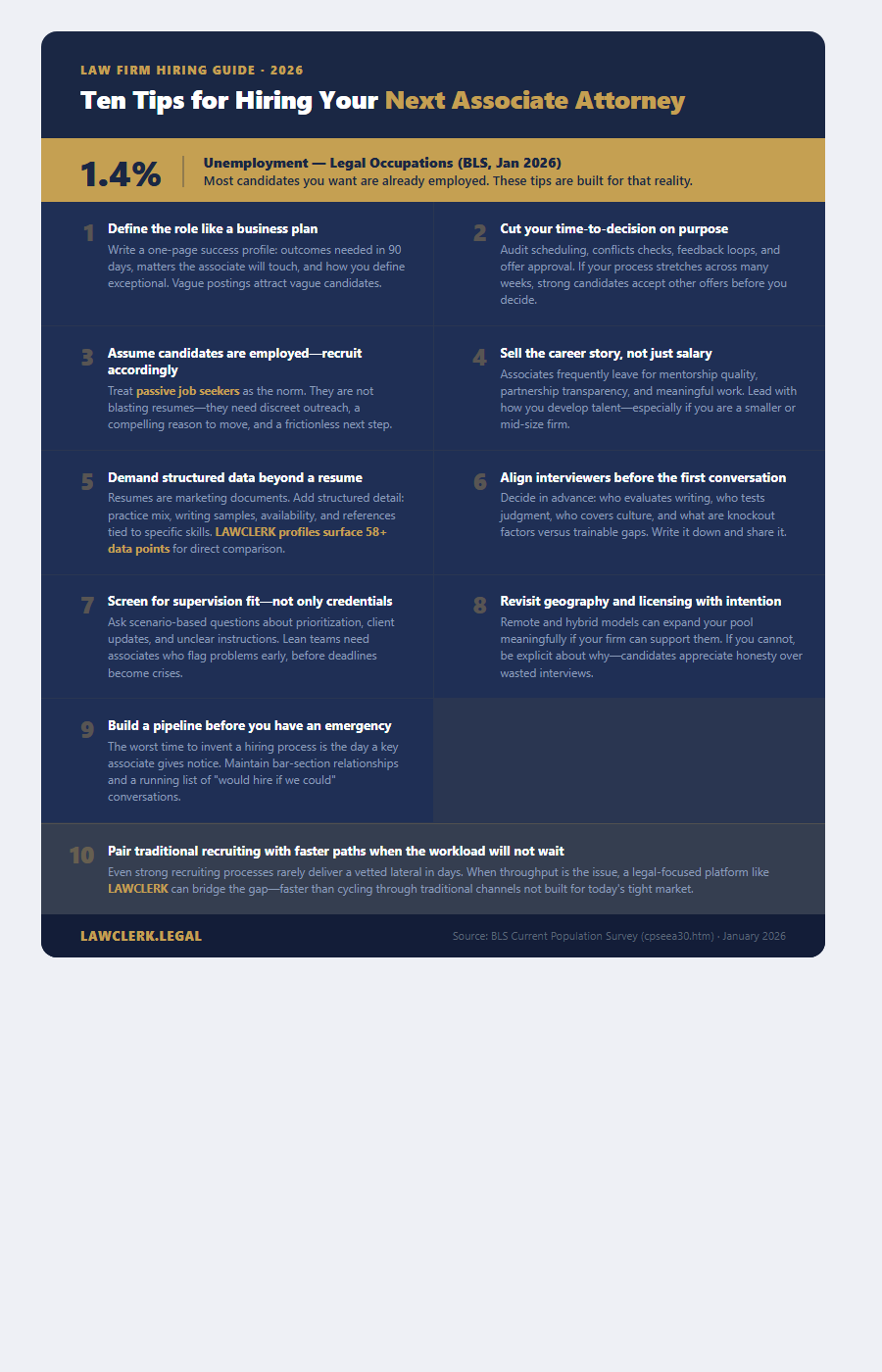
Use this checklist as a quick reference for hiring committees and firm administrators.
Questions & Answers
Why is it so hard to hire associate attorneys right now?
Unemployment in legal occupations is very low—1.4% in January 2026 per the BLS—so many firms are competing for employed attorneys rather than choosing from a large pool of unemployed applicants. Structural factors like specialization and compensation pressure add to the challenge; see our overview of the 2026 legal talent shortage.
What is a passive job seeker in law?
A passive job seeker is typically employed and not urgently applying everywhere—but open to the right opportunity. Most associate recruiting in a tight market is effectively passive-candidate recruiting.
How can law firms recruit passive candidates ethically and discreetly?
Use confidential, professional channels; avoid public announcements that compromise anonymity; and choose tools designed for attorneys rather than general job boards.
What is LAWCLERK’s role in associate hiring?
LAWCLERK provides a legal-focused environment where law firms can connect with licensed attorneys and evaluate rich profile data—58+ data points—to move faster than resume-only workflows. It is built for lawyers searching for jobs and firms searching for lawyers—not generic hiring categories.
Is LAWCLERK only for freelance work?
LAWCLERK’s ecosystem supports how modern firms actually staff: full-time-style hiring conversations benefit from the same structured legal profiles and legal-only focus, and many firms use LAWCLERK alongside traditional recruiting to reduce time-to-talent.
Conclusion
Hiring your next associate attorney in 2026 is not about hoping the market softens. It is about running a tighter process, respecting how passive candidates actually behave, and using better information than a resume alone can provide—so you can decide faster and compete for talent that already has options.
This article was developed with the assistance of AI tools and edited by Kristin Tyler.
Ready to see legal hiring profiles built the way law firms actually evaluate lawyers?
Explore LAWCLERK and connect with licensed attorneys in a platform designed for legal hiring—not generic job listings.