

If you are a managing partner or law firm administrator responsible for hiring associate-level attorneys, you already know the uncomfortable truth: there is no surplus of unemployed lawyers waiting for your job posting. When caseload spikes or a key lawyer leaves, you do not get unlimited runway to “figure it out.” Every week spent on the wrong candidate is a week your existing team absorbs more work, clients wait longer, and revenue sits trapped in the hiring funnel instead of moving matters forward.
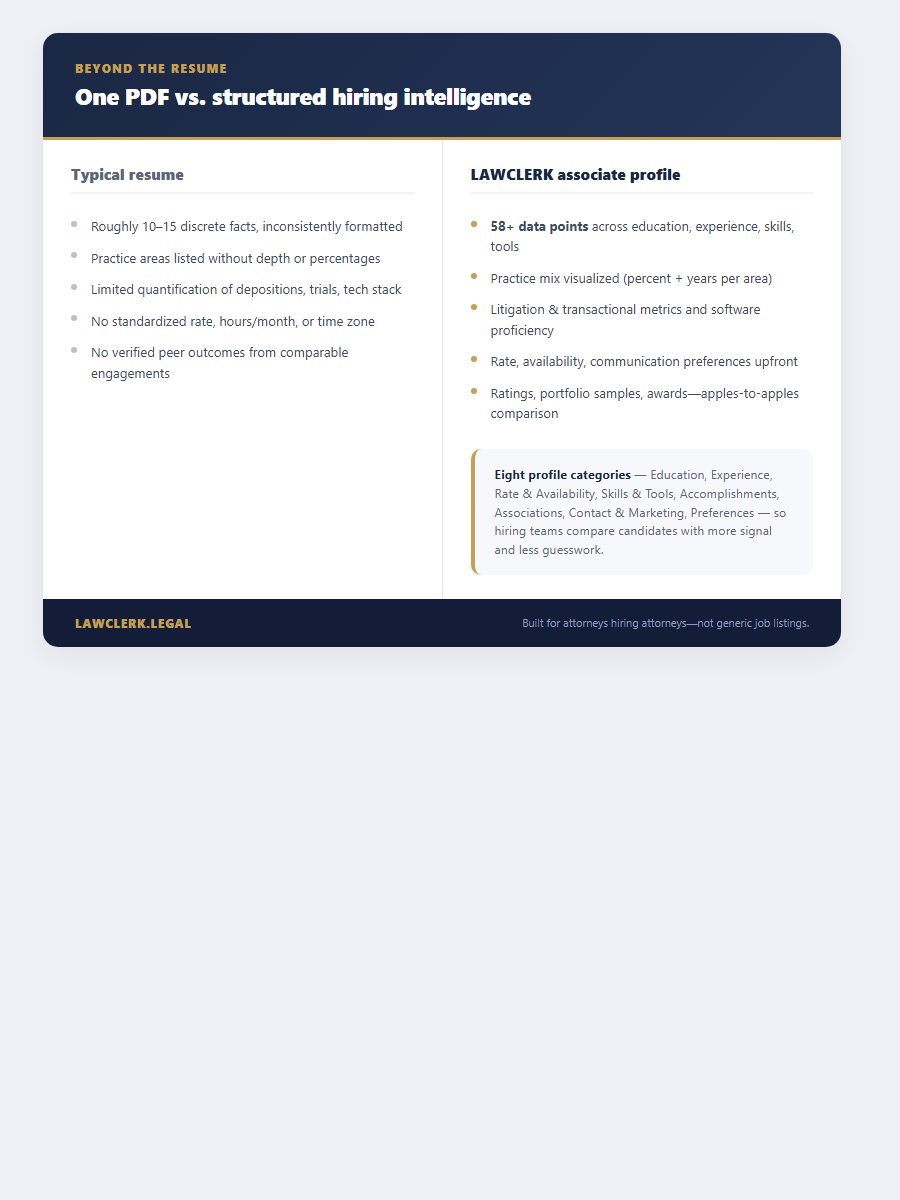
This article explains why resume-first recruiting is built for a different decade—and how LAWCLERK’s robust associate profiles (more than 58 structured data points across eight categories) give hiring teams a measurable edge when evaluating US-licensed attorneys for remote, part-time, or project-based work. We will walk through what those profiles actually contain (tab by tab), why that depth matters in 2026’s labor market, and how speed and flexibility compare to traditional associate hiring.
For broader context on why recruiting feels harder than ever, start with our overview: The Great Legal Talent Shortage: Why Law Firms Are Struggling to Hire in 2026.
When you need more attorneys, the cost of a mismatch is not theoretical
Traditional hiring assumes you can afford a long discovery phase: resume screening, callbacks, panel interviews, conflicts checks, negotiation, start date. That cadence may still work for some permanent roles—but it breaks down when deadlines do not pause for your recruiting calendar.
A resume tells you what the candidate chose to emphasize on one or two pages. It rarely answers operational questions that determine fit on day one: How much of their practice is actually in your niche? How many depositions or trials have they first-chaired? Which discovery platforms do they use? What hourly rate and monthly capacity can they commit to right now? What time zone and communication cadence keep your matters moving?
When those answers are missing or inconsistent across applicants, firms fall back on pedigree proxies—school names, brand-name employers, informal referrals. Proxies can be useful; they are not a substitute for comparable, structured credentials when you need someone productive this month, not next quarter.
The 2026 labor market: why “more resumes” is not the answer
According to the U.S. Bureau of Labor Statistics, unemployment for Legal Occupations was 1.4% in January 2026. At that level, most attorneys you want are already employed—you are competing for attention and speed, not sorting through a deep bench of idle applicants. Source: BLS Current Population Survey table—unemployment rates by occupation.
In that environment, firms need two things at once:
- Reach to licensed attorneys open to flexible engagements (not only full-time job seekers).
- Signal that replaces resume theater with consistent, relevant facts.
LAWCLERK is built specifically for that intersection: lawyers looking for work and law firms looking to hire great attorneys—not a generalist job board where legal credentials are flattened into keyword soup.
Beyond the PDF: what “58+ data points” actually gives your hiring team
LAWCLERK profiles organize attorney information into categories—including Education, Experience, Rate and Availability, Skills and Tools, Accomplishments, Portfolio, Published Works, and Preferences—totaling 58 or more discrete fields (more when candidates add multiple roles, awards, or publications).
That structure matters because hiring is not a personality contest; it is risk management. You are trying to predict whether this person can execute your work under your supervision and your client constraints. Structured data reduces ambiguity: two candidates who both write “litigation” on a resume may look identical on paper—while their profiles reveal different depth in motion practice, trial exposure, appellate work, or document review volume.
From header to tabs: what you see before you ever schedule a call
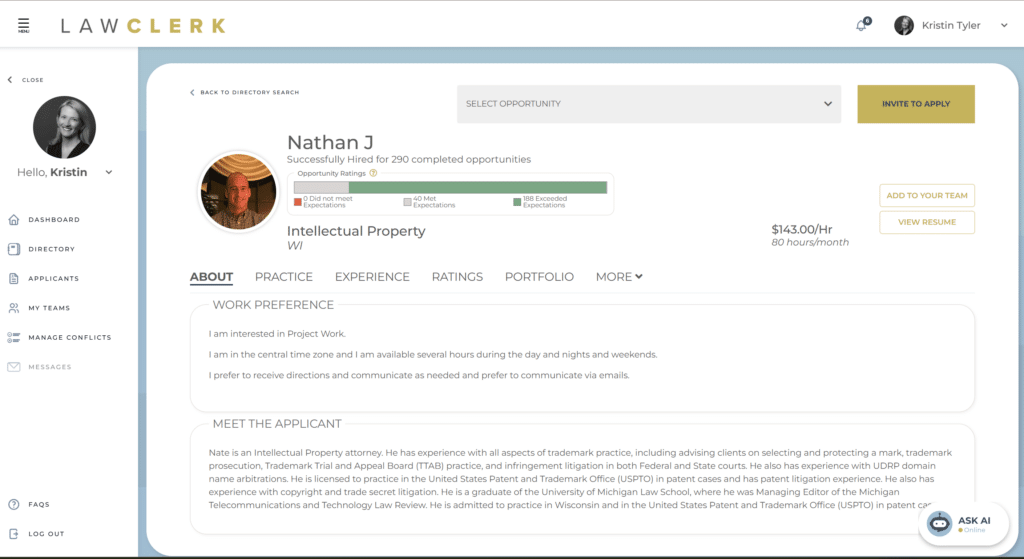
On a typical LAWCLERK attorney profile, the top of the page surfaces what firms need for a fast “fit check”: practice area focus, jurisdiction, preferred hourly rate, availability (for example, hours per month), and a snapshot of completed engagements and opportunity ratings (how often past hiring attorneys rated work as meeting or exceeding expectations). Clear actions—such as Invite to Apply, Add to Your Team, or View Resume—let you move from browsing to engagement without rebuilding your workflow from scratch.
About: work style, narrative, and fit
The About area is where attorneys summarize work preferences—availability windows, communication style, time zone—and a narrative bio that puts resume bullet points into context. For hiring managers, this is where “culture fit” starts to become legible without a first-round coffee meeting.
Practice: where resumes stop and measurable depth begins
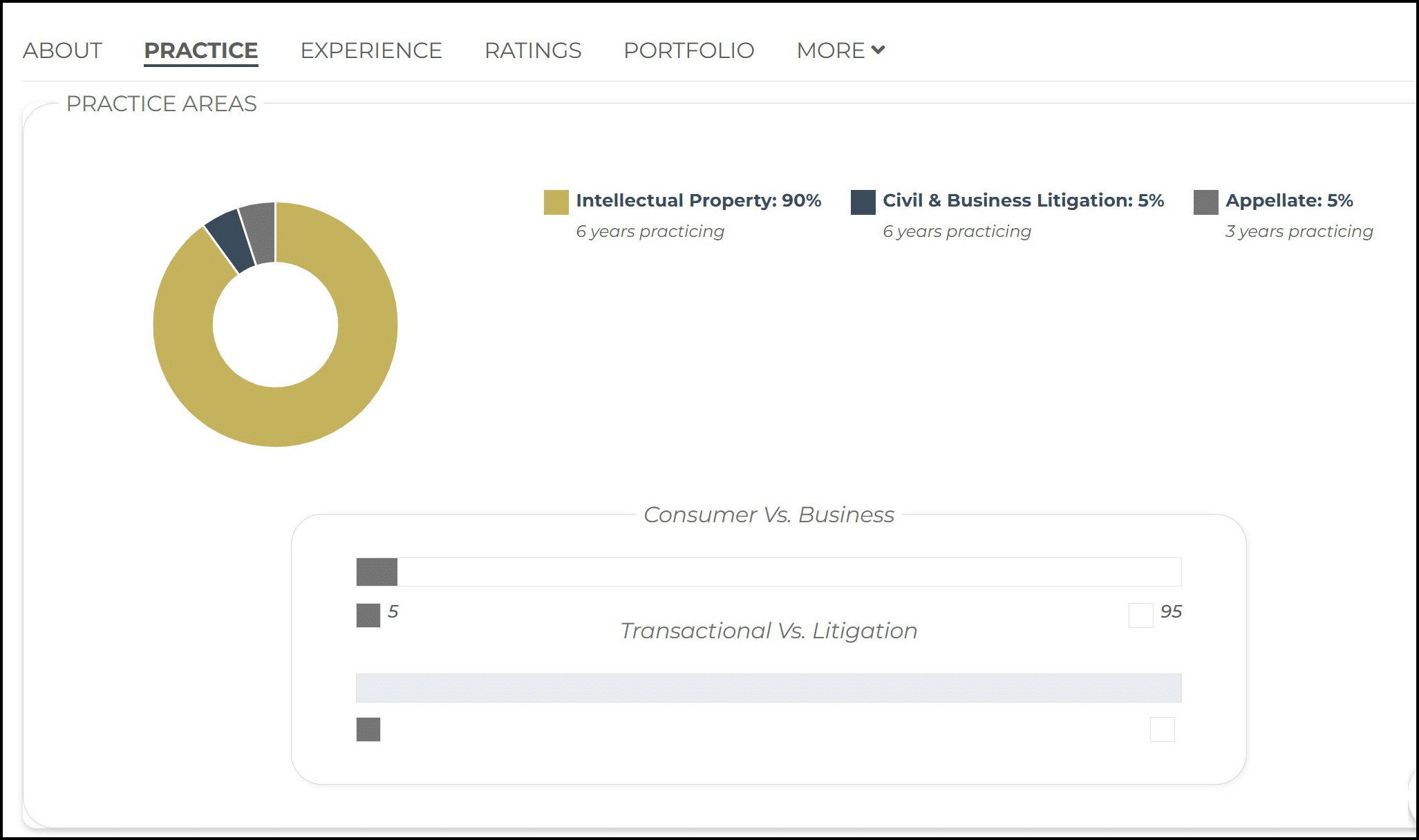
On the Practice tab, firms see practice-area composition in a visual breakdown—not a single line on a CV. Examples include percentage of practice allocated to each area (with years in each), plus comparative sliders such as consumer versus business exposure and transactional versus litigation emphasis.
That single screen answers questions resumes rarely quantify: Is this “IP attorney” mostly prosecution and counseling, or heavy litigation? Is “civil litigation” a primary focus or occasional overflow work? Those distinctions determine whether you are looking at the right attorney for your work.
Experience, Skills, and Tools: employment history that maps to your workflow
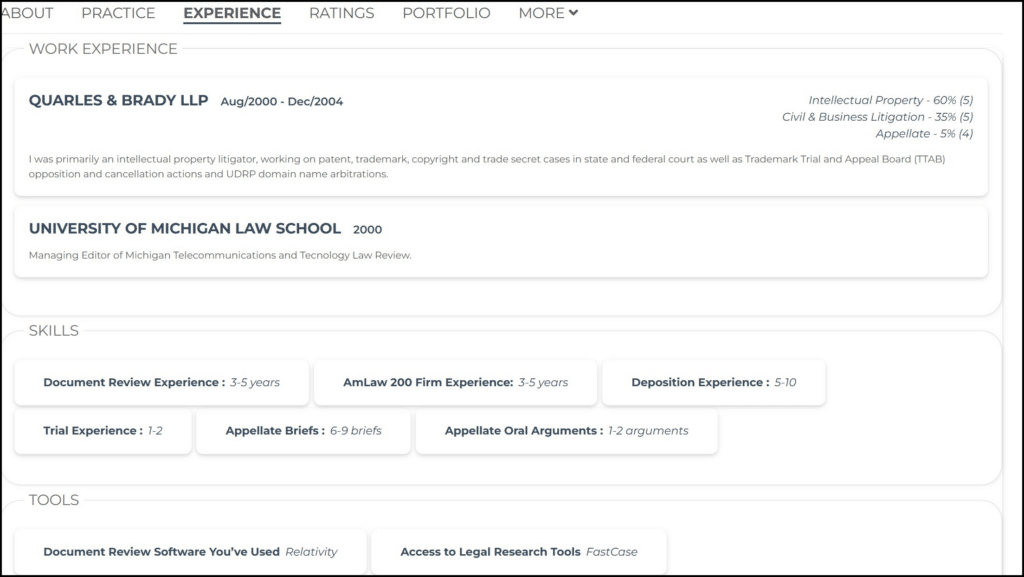
The Experience tab combines employer history with role-specific practice allocations (percent focus and narrative descriptions), then surfaces skills and tools in a consistent format—such as document review tenure, AmLaw-style firm exposure where applicable, deposition and trial counts, appellate briefs and oral arguments, plus software (for example, Relativity for review; Westlaw or other research access).
That is the difference between “familiar with discovery” and “Relativity-heavy discovery at stated volume”—which is exactly what litigation teams need when staffing discovery crises.
Ratings: peer-validated performance at scale
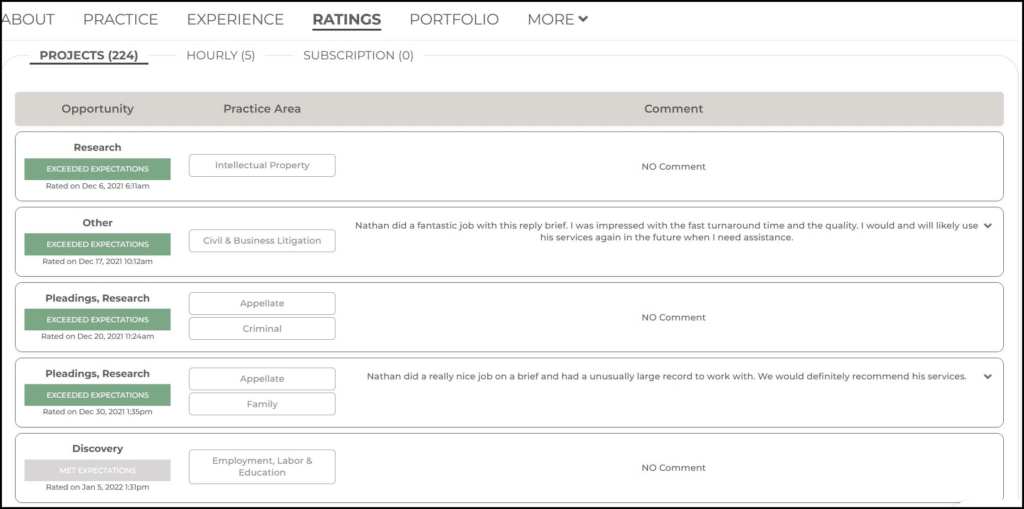
The Ratings tab turns subjective impressions into something closer to due diligence. Hiring attorneys can review outcomes tied to projects, hourly engagements, or other opportunities. You will see practice-area data, rating tier (for example, Exceeded Expectations vs Met Expectations), dates, and comments where provided.
When combined with structured credentials, ratings help answer the question every hiring attorney silently asks: Has this person delivered similar work for someone like me?
Portfolio: proof of work product
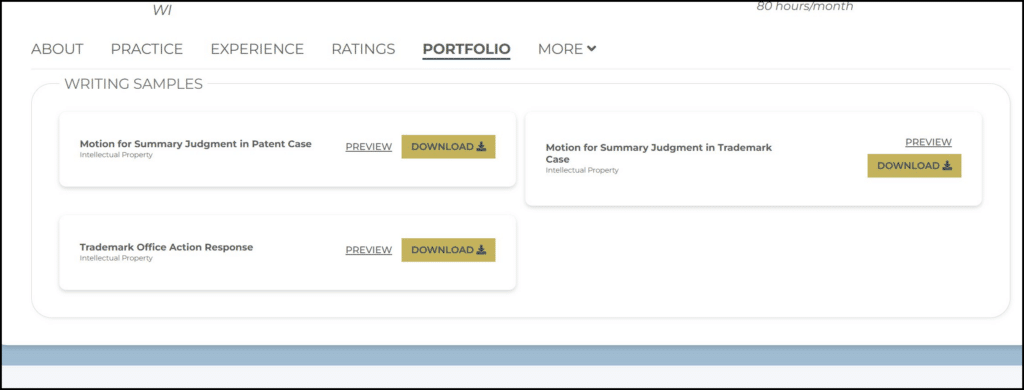
The Portfolio tab hosts writing samples and similar artifacts—often with preview and download options—so you can assess drafting style and analytical depth before investing partner time.
More: awards, publications, speaking, and philanthropic involvement
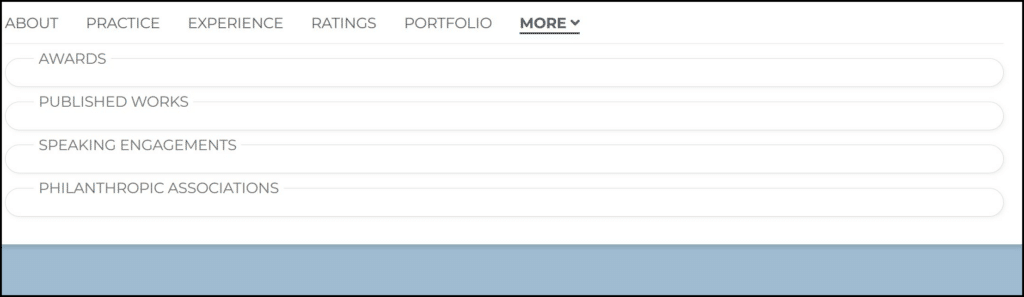
Under More, profiles can include awards, published works, speaking engagements, and philanthropic associations. This is the kind of third-party validation that resumes unevenly report.
Taken together, these tabs mean your hiring committee is not debating a PDF’s typography. You are comparing profiles built for comparison that bring the candidate to life in a way a simple resume cannot.
Speed: hiring faster when you cannot afford a nine-month lateral track
Traditional lateral searches often stretch months. Entry-level hiring may be tied to academic calendars and budgets. Neither timeline maps cleanly to a client crisis—or to sustainable workload for your current associates.
For a deeper dive on timelines and economics, see The Speed of Working with Remote Associates. The core idea is straightforward: remote, project-based, or hourly engagements are engineered for time-to-productivity—post work, evaluate structured applicants, clear conflicts, and start—sometimes within hours for discrete projects, and on days-to-weeks horizons for ongoing hourly relationships, rather than quarters-long searches.
That speed is not about cutting ethical corners. Supervision, confidentiality, and conflicts remain your responsibilities. The goal is to remove administrative friction so qualified attorneys start producing billable work under your oversight sooner.
Flexibility: outsourcing without pretending demand is flat
Full-time associate hiring is a fixed-cost commitment. Your firm pays the expense of salary, benefits, space, equipment, management overhead, and the opportunity cost of idle capacity when matters slow.
Outsourcing through a legal talent marketplace adds a flexibility knob: scale hours up when demand spikes, dial back when it normalizes, and engage specialists for narrow needs without inventing a permanent role. Remote arrangements expand geography which is critical when local lateral markets are tight or when niche expertise is scarce.
Used thoughtfully, flexible staffing is not a substitute for every permanent hire. It is a parallel track that preserves throughput while you recruit or it can become a long-term capacity strategy when workflow is inherently uneven.
Many firms will continue to run traditional recruiting for core associate roles while simultaneously using flexible freelance engagements to absorb spikes, cover parental leaves, or launch new practice lines without permanent headcount. The profiles described above matter in both worlds: even when a hire is ultimately full-time, structured vetting shortlists stronger finalists faster—and when the need is interim, you already know how to read the signal.
Conclusion: better data, faster paths, smarter decisions
Resumes will remain part of legal hiring, but they should not be the entire dataset, especially when unemployment for legal occupations is measured at 1.4% and firms compete for the same finite talent.
LAWCLERK’s associate profiles are designed to answer the questions resumes skip—then pair that clarity with hiring paths built for speed and flexibility through remote, US-licensed attorneys.
Ready to evaluate candidates with more than a PDF? Create a free account at lawclerk.legal, browse the directory, and invite strong fits to apply. In addition, you can always talk with our team about hourly and project workflows that match your firm’s needs.
This article was developed with the assistance of AI tools and edited by Kristin Tyler.
FAQ: LAWCLERK profiles, hiring edge, and remote associates
What does LAWCLERK offer beyond a resume?
LAWCLERK attorney profiles include 58+ structured data points across eight categories—education, experience, rate and availability, skills and tools (including litigation metrics and software), accomplishments, associations, contact and marketing (such as video introduction where provided), and preferences—so firms compare candidates consistently.
Why does structured profile data matter for hiring attorneys?
It reduces guesswork by surfacing quantified practice exposure, tools, availability, and engagement history in a standardized format—critical when legal unemployment is low and speed matters.
How fast can a law firm hire through LAWCLERK compared with traditional associate hiring?
Traditional searches often take months. LAWCLERK supports faster paths for remote and flexible engagements—see The Speed of Working with Remote Associates.
Is LAWCLERK only for full-time hires?
No. LAWCLERK connects firms with attorneys for project-based work and hourly arrangements as well—ideal when firms need capacity without a permanent fixed-cost hire.
What is the legal unemployment rate referenced for 2026?
The BLS reported 1.4% unemployment for Legal Occupations in January 2026. Source: BLS CPS table.
Why are law firms struggling to hire in 2026?
See The Great Legal Talent Shortage: Why Law Firms Are Struggling to Hire in 2026.